
 PLO: The History of the Great Cockroach
In 1948, the State of Israel was proclaimed. Palestine was lost. Sixteen years later, in 1964, the Palestine Liberation Organization, or the PLO, was founded.
Made up of different factions, the PLO has been at the heart of the struggle to regain Palestine ever since.
Expelled from Jordan and then Lebanon, the PLO seemed to be running out of options. Forced into a corner, its leader Yasser Arafat soon found himself engaged in a fratricidal fight for the control of the PLO and for his life.
With the withdrawal of the bulk of its forces from Beirut, the PLO was in limbo once again. Few Arab countries wanted to welcome thousands of Palestinian fighters. For the first time, the PLO's existence in exile would be without the military force that had characterized its stays in Jordan and Lebanon.
The price of defeat in Beirut soon appeared before Arafat. The weakened PLO leader found himself under attack from Palestinian leaders within the PLO and even from within his own Fatah faction. The critics said Arafat's style of leadership was too autocratic and they accused him of abandoning the revolution by evacuating Beirut and seeking a negotiated settlement.
Abu Khaled al-Amleh, Fatah Infitada: Yasser Arafat wants to abandon the struggle. We want to continue it. He came to Damascus and attempted a coup in Fatah to kill the revolution which we want to preserve. Arafat has sold out the cause. He is no longer interested in the revolution.
Syria, which had always wished to make the PLO subservient to its will, sought to exploit Arafat's vulnerability.
Mamdouh Nofal Senior DFLP Official: Every defeat has a price and the part of the price was the split. At the time, Syria tried to settle the score with the PLO leadership. What transpired was a Syrian attempt to dominate Palestinian decision-making through direct Syrian intervention or through serious Palestinian tools. That was met with a resolute defence of independence of Palestinian decision-making. The Syrian intervention found a fertile breeding ground of differences and power struggles within Fatah


Salah Salah PFLP: Arafat bears a direct responsibility for the split in the PLO. There were two choices then. Arafat made the choice that the resistance was futile.
Palestinian opponents to Arafat formed breakaway groups. Splitting from Arafat's main Fatah faction, one group called itself Fatah Intifada. Syria and Libya were only too willing to support the rebels. The tensions within the PLO were rising. The battle lines of a fratricidal struggle were beginning to appear.
Abu al-Abbas, Secretary-General PLF: "Objectively speaking, in the beginning, the demands made to Arafat were just demands impossible to realise. I presented them to him. He said he could accept them, but he distrusted the intentions of his opponents. I conveyed his acceptance to Fatah Intifada. It was very obvious that they had no intention to arrive at an understanding. I was convinced that there was a conspiracy and that the split saw the end of the conflict. It served the interests of certain Arab countries. It was a joint Syrian-Libyan decision."
Nayef Hawatmeh, DFLP Secretary-General: We called for a dialogue to resolve the differences between both wings of Fatah. That was rejected by Arafat's opponents in Fatah Intifada. They thought they could take complete control of Fatah. On the other hand, Arafat's Fatah was initially receptive to our proposals.
Arafat's arch-rival, Abu Nidal, quickly allied himself with the anti-Arafat faction. In April of 1983, at a meeting in Portugal, the Abu Nidal organisation assassinated Issam Sartawi, a leading PLO moderate and Arafat representative who had been negotiating with Israeli doves. Israeli leader Shimon Peres, also in attendance, was left alone.
Abu Daoud, Senior Fatah Leader: "We caught Sartawi's assassin later on. I saw him in Tunis and I asked him why he hadn't also shot Peres. He said his orders were to kill Sartawi, only Sartawi. One day I hope to write an article about Abu Nidal and Sartawi. I will call it, who is the traitor, the murderer or the victim? The victim was innocent and honourable, a man who knew where his people's interests lay. But the murderer was a tool and a traitor. Abu Nidal discredited the Palestinian cause in the eyes of the world when in 1985 two of his European cells attacked Rome and Vienna airports, killing 18 and wounding 140 people. A CIA document at the time claimed that Abu Nidal had not attacked a single Israeli target that year."
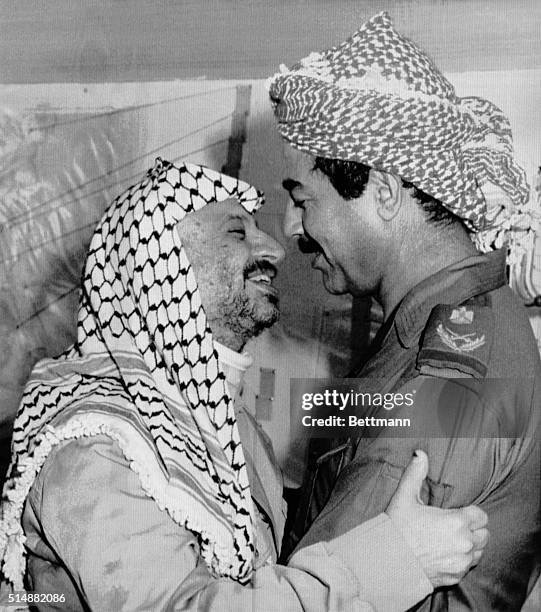 In June 1983, Syria declared Arafat persona non grata and expelled him from Damascus. The break was cemented.
Interview with Arafat: So what's going on now? As you see, you have to go there on the field to see by yourself what is going on. What do you mean exactly? No, no, no, I am leaving after, I have a meeting here, after the meeting I will leave. You are meeting with whom? With the President. You are leaving to where? It's better for you to wait and see. Anything to comment? What's going on now? Everything is going in an excellent way. Thank you.
Abdul Halim Khaddam, Syrian Foreigh Minister: The Syrian forces' position during the conflict was that of separating the warring factions. And on the third day, we were surprised by a letter sent by Arafat to a number of presidents of the Arab countries which was spread by the media. It included a campaign of slander and lies and incitement against Syria and against its armed forces, accusing the Syrian forces of striking the sites of the Palestinian revolution.
Abu Iyad Fata CO-founder. PLO Intelligence Chief: No one can harm Fatah. Fatah is very strong and no one can harm its leadership or unity. We cannot be dictated to. It would be very easy to get on a plane and go and surrender to Syrian President Hafez al-Assad. I assure you if Fatah did that, both the problems and the factions would vanish. But we are against this for the sake of our people and the dignity of this movement and its martyrs.
Walid Jumblatt, Lebanese Politician: Hafez al-Assad had grand strategic calculations. He viewed the Palestinian issue as his to guard and preserve. There is no such thing as the independence of Palestinian decision-making in the Syrian lexicon. Syria's Foreign Minister once told me so and he added, "Palestine is southern Syria."
In July 1983, fighting broke out in the Beqaa Valley in Lebanon between pro- and anti-Arafat forces. Arafat now faced an armed revolt against his authority by pro-Syrian elements within the PLO. Arafat loyalists, who had found their way back to Lebanon, were besieged by the Syrian army and its Palestinian allies in the city of Tripoli in north Lebanon. In a daring air and sea journey from his new headquarters in Tunisia, Arafat managed to slip into Tripoli in disguise to join his fighters. Pro-Syrian Palestinians responded immediately.
Tareq al-Khadra, Chief of Staff, PLA: Arafat is no longer the legitimate chairman of the Palestinian Liberation Organization and he only represents himself and the Palestinian people have washed their hands of him.
The defence of Tripoli was led by Arafat's deputy Khalil al-Wazir, better known as Abu Jihad. Abu Jihad: "It's the matter of the Syrian decision." He rejected the description of the ongoing battle as a purely Palestinian affair. "You see those are, which tank is it? It's the tank from the Syrian army, you see. You can look, you can follow it. It's the T-54, you see. T-54 coming from the Syrian army, you see. Brought to them. And they are led also by Syrian commanders, you see."
Arafat's opponents kept up the attacks, claiming they had the support among Palestinians in the occupied territories.
Samih Abu Kwai: Fata Infitada: We concede that Yasser Arafat used to be a symbol for our people, but the people are beginning to gradually see the truth and realise what is happening. This person, who was entrusted as a fighter for the independence of Palestinian decision-making, is now abusing his position.
Such claims were not borne out by facts on the ground. Palestinians in the West Bank and Gaza rallied around Arafat. He expressed a philosophical view of the ongoing conflict.
Arafat: "You have to understand what the meaning of war is. War is a loud voice for policy."
The loud voice of politics was taking a heavy toll on the residents of Tripoli. Faced with mounting pressure to end the conflict, Saudi Arabia's foreign minister travelled to Damascus and announced an agreement had been reached to end hostilities and evacuate Arafat's forces from Tripoli.
Saud al-Faisal: Saudi Arabia Foreign Minister: "We have reached an agreement here based on the two principles that all parties have agreed to. These principles were to prevent any destruction of the city of Tripoli and stop the fighting between the factions around Tripoli and call for the withdrawal of Palestinian armed forces out of Tripoli. All these principles have been enunciated in this document."
The United Nations made arrangements for Arafat and 4,000 of his fighters to depart the coastal Lebanese city on board five Greek ships. Following his second expulsion from Lebanon, Arafat once more defined the enforced exile as another step towards victory.
Arafat: "This is a part of the long march to our independent state, to our capital Palestine, Jerusalem."
Beyond the rhetoric, Arafat seemed a spent force. But the elusive Palestinian leader had another card up his sleeve. Short of friends, Arafat travelled to Cairo to meet Egyptian President Hosni Mubarak. It was a bold and dramatic act. Arafat became the first Arab leader to meet an Egyptian president since former President Anwar Sadat had signed a peace treaty with Israel in 1979. The Arab world was thunderstruck.
Bassam Abu Sharif, PFLP: "He thought long and hard. Do not imagine that it was an easy decision for him. He knew that he would antagonize the Fatah leadership because he didn't consult them. And he knew that Syria would brand him a traitor. In the end, as he always did, Arafat made the decision because he was convinced that it served the higher interests of the Palestinian people. But he was fully aware of the risks it entailed and that the people who loved and supported him would find it incomprehensible."
Arafat's visit was a diplomatic coup for Mubarak. And in subsequent years, Egypt would increasingly become the PLO's main patron. Arafat's opponents within the PLO accused him of betraying the Palestinian cause. Syria castigated him as a traitor. Under attack, Arafat sought political refuge with his former adversary, King Hussein of Jordan. Since the PLO's expulsion from Jordan, relations between the two leaders had always been uneasy. But Arafat and King Hussein now came together in an uneasy alliance. The king allowed the Palestinian parliament in exile to convene in the Jordanian capital, Amman, in 1984. This proved a lifeline to Arafat. His ability to convene the Palestine National Council with the required quorum allowed him to maintain the legitimacy of his leadership of the PLO.
Abu al-Abbas, Secretary-General PLF: "We looked for locations to hold the PNC meeting. There were suggestions of holding it on board a ship. If that session of the PNC hadn't taken place, the PLO wouldn't have finished and Palestinian legitimacy lost. So in spite of our reservations, it was convened in Amman."
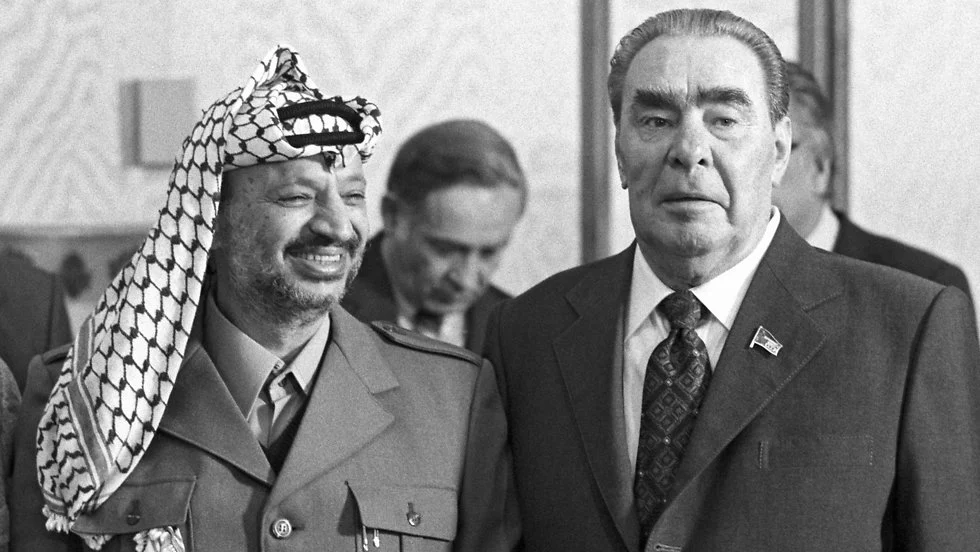
The Jordanian PLO rapprochement led to the signing of the Amman Accord in February 1985. According to its terms, the PLO and Jordan would form a joint delegation to future negotiations for resolving the Arab-Israeli conflict. Syria opposed the accord and sought to exact retribution for Arafat's move. Once again, Lebanon was the battleground. The Syrian-backed Amal militia and anti-Arafat factions besieged the Palestinian refugee camps in Beirut and southern Lebanon. The camps were subjected to an on-and-off siege and onslaught for the next three years.
Salah Salah PFLP: "Amal could not have become involved had the Syrians not asked them. The request was made to several Lebanese parties that all declined to have the responsibility of shedding Palestinian blood on their hands. Amal accepted the task."
The fighting and the harrowing experiences for the refugees would be termed the "Ccamps War."
Robert Fisk: "There were war criminals there too. Palestinian women were being shot in the head as they went for water, deliberately. And those criminals are walking around us, among us today. I can remember the savagery. I can remember one day, with so many Amal were firing so many machine guns, I mean, you know, weapons into the camp, that there was a rustling sound, like, they'd go, and then you'd hear, and it took me several minutes to realise what it was. They were firing so many bullets that the bullets were touching each other in the air as they were going into the camp. Walls of steel, all touching each other, all the bullets. Rustling, like silk being torn up, you know.
Volunteer Doctor: "One girl here was shot in the leg as she was trying to bring in food through the entrance that they now call the death passage. And another lady here who has a fractured hip, she was shot in the hip. They're forced to go out still to bring in food, and almost every day women are shot."
Comparisons were being drawn between the Sabra and Shatila massacres and the new camps war.
Mamdouh Nofal Senior DFLP Official: "That war was very bloody and lasted a long time. The massacres perpetrated against the Palestinian people in that war were worse than the Sabra and Shatila massacre. It was a wholesale destruction and indiscriminate killing. The Amal leadership should apologise to the Palestinian people if it genuinely wants closure. We have a record of everything, names and numbers."
Volunteer Doctor: They managed to crawl in from outside, they brought it from outside, and they crawled in over the sand hills. And this is the second time that these girls have managed to come in in this way. Gunshots!
Camp Hospital Director: "We feel that nobody is feeling what we are suffering here. It's just a siege to continue killing the people. I can't see any political future or any victories for those who are besieging the camp. Or even we can say that our people inside the camp are not looking for victories, just looking for peace and to live in a secure, honourable life only. And I hope that the world around us can hear these words and try its best to help our people to lift this siege.
Arafat suffered a further blow when Israeli warplanes raided his PLO headquarters in Tunisia, killing 160 people. Yet again, Arafat survived. The PLO leader continued to be elusive in political matters as well. Jordan's repeated attempts to induce him to honour the terms of the Amman Accords proved futile.
Prince Hasan bin Talal: "Chairman Arafat was a mercurial personality. He never kept any agreement he made with an Arab country if he found a more lucrative offer elsewhere. With the Amman Accords, he replaced the term confederation with the term twinning, as in twins. But this term has no basis in international law. It was the beginning of the end of the Amman Accords."
Adnan Abu Odeh, Advisor to Hussein: Arafat had no real intention to commit to the agreement. It was more of a manoeuvre than a real attempt at finding a solution. I went to him to sign a document pertaining to the Amman Accords. He asked for some time to confer with the PLO leadership, left and didn't return. So we had a joke about him going missing.
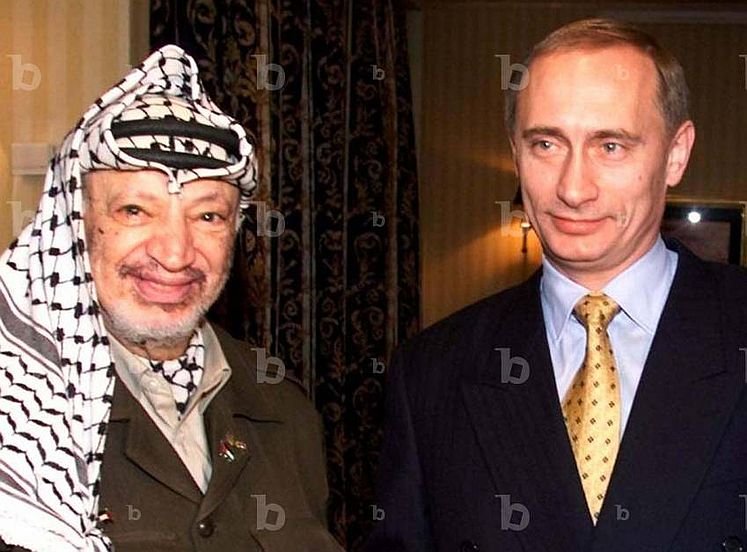 It was a genuine attempt to cooperate with the PLO. Having had enough, Jordan announced the abrogation of the Amman Accords almost one year after they had been signed. The Jordanians severely curtailed the activities of the PLO and expelled Abu Jihad.
Yitzak Rabin: I was satisfied to hear this evening a statement that was made public by one of the members of the cabinet in Jordan. That they intend to close 25 out of the 32 PLO offices in Jordan. To put more restrictions on the activities of the PLO in Jordan.
Abu Jihad: "We are not in one cage, as some are thinking. If we are in Lebanon or in Jordan having some problems or in Syria, that will not put an end for the PLO or for our Palestinian struggle. We are still alive everywhere as Palestinian people. We are still alive in our occupied territories facing the Israeli occupation.
Despite Jordanian frustration, many Palestinians believed Arafat had accomplished a masterly stroke.
Mamdouh Nofal Senior DFLP Official: "The Amman Accords was a brilliant tactical maneuver executed by Yasser Arafat. He used it to gain some breathing space. He established relations with Jordan, signed the agreement and then abrogated it."
Arafat: "I was expecting this escalation from the Jordanian government."
As for Arafat himself, he feigned ignorance as to what had gone wrong. "But it seems that in spite of all our efforts to cool down, they are insisting to make these troubles which will affect indirectly or directly the Jordanian-Palestinian relation."
But Arafat paid the price of his political maneuvering. At an Arab summit in Amman in 1987, King Hussein refused to receive the Palestinian leader at the airport. As well as this diplomatic snub, the Palestinian issue was relegated to the periphery of the agenda. Arafat departed, claiming he was satisfied with the results of the summit. But he appeared to have reached the limits of his tactical capabilities. But, as before, the PLO leader found a lifeline. It was to come from an unexpected source. After decades of oppression, the Palestinians still living in the occupied territories were about to raise their voices.