The article, from which this is taken, was written by an anti-Zionist propaganda zealot but the sections I've kept are a good brief introduction.
Note the the author always compares the amount of Jewish land purchased (cultivable land) to the total land of Palestine until page. Nearly two thirds of the land was not cultivable. This dishonest statistical trick is not worthy of the author
Meaningless Phrases
the occupied West Bank, the Palestinian question, right of return, a genuine national movement, the forces of the Palestine revolution, occupied Palestine, Zionist Entity, illegal settlements
The Journal of Liberation Studies, Vol. V, No. 4 (Fall 1981)
The Alienation of a Homeland: How Palestine Became Israel*
by Stephen P. Halbrook
George Mason University / Virginia State Bar
How Palestine Became Israel
While the historical accuracy of her claim that the Palestinian people are of Canaanite origin may never be resolved, E. A. Finn's turn of the century depiction of Palestine's traditional inhabitants provides insight into their attachment to the land. The Ottomans who ruled Palestine for four hundred years found the indigenous population to consist of the following:
First, the Bedaween, "Arabs of the Arabs," who live in tents and roam the deserts.
Second, the Fellahheen. "Ploughmen," or agricultural peasantry, who live in villages, and are freehold owners of the soil which they cultivate.
Third, the Belladeen, "Townsfolk," who live, and who have lived from generation to generation, in cities, generally in their own freehold houses.3
While not politically united in the sense of European nationalism, the Palestinians, particularly the peasantry, were held together by a common language, religion, custom, and hatred for Turkish rule. "Though they have with each other no national cohesion, the Fellah clans cleave to the land with the tenacity of aboriginal inhabitants, … They cling to the hills and the plains where their fathers lived and died."2
While the peasants perceived their right to their land to be based on long-standing possession and cultivation, the Ottoman code regarded the ultimate landowner to be the Sultan, whose agents would terminate tenure for nonpaymentof taxes or rent. Fellaheen were severely exploited by tax farmers, who, backed by troops, doubled as moneylenders at rates of 60% interest, and not surprisingly the State was regarded as an organized band of robbers.3
The Land Registration Law of 1858, ostensibly passed to determine title to land, was actually
a means of identifying properties for the purpose of taxation and of disclosine the existence of persons subject to military conscriution. For these reasons only a small proportion of transactions was recorded, and these chiefly concerned elderly persons, females, foreigners and those sufficiently influential to be able to avoid military service. As an index of owners, the registers therefore became hopelessly incomplete. … In order to avoid taxation, a person owning some hundreds of dunums had them recorded as an area of, say, ten or twenty dunums.4
Peasants who registered their land at all often did so in the names of deceased or fictitious persons or of members of the effendi (gentry) or of urban merchants. Title thereby existed in the names of upper class Moslems, Christians, and Jews in Jerusalem, Beirut, and Damascus. Members of the urban elite filed whole villages in their own names, and tenure passed into the hands of those who were often landlord, tax collector, and usurer all in one. The bribing of officials and the blackmailing of peasants also played a role in the recording of ever more land in the names of absentee landlords.5
The concentration of title to land was aided by the land tenure system provided in Ottoman law, which recognized the following:
- ) Mulk, comparable to the fee simple in English law and existing only among a few members of the ruling elite;
- ) Miri, the most common form of tenure, consisting in absolute ownership by the State and lease to private individuals subject to paymentof the land tax;
- ) Waqf, really consisting in miri except that, upon expiration of the founder's line, it passed to charitable purposes;
- ) Metruke, common land used for roads, grazing, etc.; and
- ) Mewat, dead or waste land claimed by the State but often used by Bedouin or Fellaheen.
It should be noted that miri could not be mortgaged, so a bankrupt debtor was forced to transfer his rights to the usurer, who would allow the peasant to remain on the land in exchange for two-thirds of the crops.
In the latter part of the nineteenth century, while title to land traditionally held by Arab peasants was being transferred to Arab and Turkish landlords, another force emerged which was to have the most significant influence on the distribution of land, namely, the Zionist movement which began to support immigration of Jews to Palestine. While reliable statistics do not exist, it has been estimated that Palestine in the second half of the nineteenth century consisted of a population of more or less a half million, of which some 80% were Muslims, 10% Christians, and 5 to 7% Jews. In 1882 Jews owned 22,500 dunums of land out of the 26,323,000 dunums which were to make up Mandate Palestine, i.e., .09% of the land. By 1900 there were 50,000 Jews in Palestine, mostly in Jerusalem and Jaffa, although twenty-two settlements existed by then, and Jews owned 218,000 dunums, or .8% of the land.6
The increase in Jewish ownership was largely prompted by the founding of the Palestine Jewish Colonization Association (PICA) by Baron Edmond de Rothschild, the "Father of the Yishuv" (the Jewish settlement in Palestine) who for decades was to be the largest Jewish landowner in Palestine and Transjordan. Rothschild "bought land from the feudal Effendis, sometimes by bribing the Ottoman administration, and drove the fellahin off the land."7 Some of the same fellaheen were hired to work the land they once cultivated as their own.
A different approach was taken by Zionists of a more purist position than the classic colonialist policy held by Rothschild. "When we occupy the land … we must expropriate gently the private property on the estates assigned to us," wrote Zionism's founder Theodor Herzl. "We shall try to spirit the penniless population across the border by procuring employment for it in the transit countries, while denying it any employment in our own countries." In 1907 the World Zionist organization incorporated the Keren Kayemeth Leisrael (Jewish National Fund), which was dedicated to purchasing land exclusively for Jews and refusing employment to displaced Arabs. Beginning a year later with the building of a suburb outside Jaffa which came to be known as Tel Aviv, Keren Kayemeth was destined to be the major landowner in Palestine.
During the last years of Turkish rule in Palestine, the lands seized from Arab peasants by Arab absentee landlords were in turn being sold to Zionist settlers whose policy increasingly was to deny employment to Arabs. Only 144 Arab landlords owned a total of 3,130,00Q dunums in Palestine-in the Jezreel Valley alone the Sursuk family of Beirut and Egypt held title to 230,000 dunums-and "the great majority of land bought by Jews in the period of Turkish rule, and later under the British Mandate, … was acquired from proprietors of large estates."9 By 1914 Jewish ownership of land amounted to 418,000 dunums or about 1.6% of Palestine, and Jews constituted 84,660 (12%) out of a population of 689,275.10
"His Majesty's Government view with favour the establishment in Palestine of a national home for the Jewish people," wrote British Foreign Secretary Lord Balfour to Lord Lionel Rothschild in November 1917, adding that "nothing shall be done which may prejudice the civil and religious rights of existing non-Jewish communities in Palestine," i.e., the overwhelming majority of the population consisting of Moslem and Christian Arabs.
Before October 1920 Jews held 650,000 dunums and land sales quickly increased under the British Mandate. The first significant Keren Kayemeth purchase of seven Arab villages was a factor in the 1921 Arab uprising which led Britain to enact the Transfer of Land Ordinance (1921), whereby the landlord was required to see that tenants uprooted by sales retain land elsewhere. Landlords evaded the ordinance simply by evicting tenants before sale. Comparable acts to protect cultivators passed in the following two decades were also evaded, increasing the number of landless Arabs.12 In any case, the first real census of Palestine, taken in 1922, indicated that Jews numbered 83,794 outof a total population of 757,182. Thus Jews, about three-quarters of whom lived in the Jerusalem-Jaffa area and about two-thirds of whom were European immigrants, constituted 11% of the population.12 Estimates respecting distribution of land indicate that in the same year, excluding freehold fellaheen, three million dunums of the land of Palestine were held by only 120 Arab families.14 By 1927 Jewish land holdings more than doubled from the start of the war to 865,000 dunums-still only 3.3% of Palestine.
A year after the 1929 revolt in which fellaheen and especially bedouin played a major role, the Simpson Report estimated that about 30% of Arab villagers were landless. Unlike the Jews, who had favorable, long-term leases, Arab tenants held land on a yearly basis, terminable at the landlord's will. The economic condition of the fellah was desperate, for scarce capital, heavy debts, rising rent, overtaxation, and high interest were crushing this class. One study showed the average fellah family in possession of about seventy-five dunums, while double that amount would have been required for a decent standard of living.15 Peasants borrowed at 30% interestor more, or sold their land, in order to pay the tithe (which might be a fourth of a fellah's income) and other taxes, debts, and subsistence expenses. Cultivators without land were required to give the landlord whose land they worked about half the produce. The fellaheen were literally bankrupt- 64% of the families in one subdistrict had execution proceedings pending against them, a family's whole crop could be attached for taxes, and imprisonment for debt was extensive. The condition of the fellah was hardly better than under the Turks.l6
While the Jewish Agency pressed its claim to all lands owned by the government, considerable areas over which the government had de jure claims had been occupied and cultivated by Arabs for very many years. Not only were areas available for Jewish settlement "negligible," but already Jewish settlements were interfering with the rights of grazing and cultivation of bedouin, the majority of whom wandered in Beersheba as in ancient times. Fellaheen who were evicted from their lands in the countryside, on emigrating to the cities, found that the Histadrut (Jewish Labor Federation) excluded them from employment in Jewish industry and commerce, resulting in serious unemployment.17
Zionist policies faced Arabs with discrimination based on race, religion, or national origin at every turn: Kibush Hakarka (Conquest of the Land) took the Arab tenant's land, Kibush Ha'avoda (Conquest of Labor) prevented the hiring of Arabs as employees, and T'ozteret Ha'aretz (Produce of the Land) imposed a boycottof Arab produced commodities.18 The Constitution of the Jewish Agency (1929), Art. 111, declared: "Land is to be acquired as Jewish property … [and] held as the inalienable property of the Jewish people. The Agency shall promote agricultural colonisation based on Jewish labour, and in all works or undertakings carried out or furthered by the Agency, it shall be deemed to be a matter of principle that Jewish labour shall be employed. … " The Keren Kayemeth lease contained the restrictive covenant based on race that the holding shall never be held by any but a Jew and that only Jewish labor could be employed in connection with cultivation of the holding. Jewish lessees who hired or attempted to sell rights to Arabs were to have their own leases terminated.19
364 THE JOURNAL OF LIBERTARIAN STUDIES Fall
The census of 1931 revealed an Arab population (including Moslems, Christians, Druses, etc.) of 861,200 and a Jewish population of 174,600, i.e., 17%. The same estimate of 66,553 bedouin as suggested in 1922 was used, as if no population increase ever occurred among this sector of the Arab population.20 While the doubling of the Jewish population (which was about half European) since the previous census was due primarily to immigration, the increase in the Arab population resulted from natural causes. With further Jewish immigration and land purchases in the thirties, foreclosures by absentee holders of legal title who often resided in Damascus, Beirut, Cairo, and Kuwait dispossessed an ever increasing number of fellaheen. The sale by the Lebanese Sursuk tax farmer family of 240,000 dunums alone displaced almost 9,000 persons.21
TABLE 1
Land Acquisitions of the PICA, Keren Kayemeth,
and Palestine Land Development Company as of 1936
Source of data: Granott, The Land Syslem in Palestine, p. 277. (See n. 22, infra.)
By the end of 1936, the PICA, Keren Kayemeth, and Palestine Land Development Company-all Zionistorganizations-held title to land as indicated in Table 1. As the former director of Keren Kayemeth com- mented: "If we add up all these figures, we shall find that no less than 90.6 per centof all acquisitions were of land which formerly belonged to large landowners, while from fellaheen only 9.4 per cent was purchased."" While it is not known how many Arab tenants were thereby evicted, in 1936 Jewish landownership amounted to 1,231,000 dunums. It is not surprising that when Arab workers and peasants, sparked by al-Qassam's guerrilla offensive in the countryside, rose up in armed struggle and engaged in general strikes during 1936-39, the feudal elements led by al-Husseini favored a compromise with the British, who, aided by the Zionists, crushed the revolt.
A Survey of Palestine, prepared for the Anglo-American Committee of Inquiry in the mid forties, described the continuing dispossession of the fellaheen in the same manner as had the Simpson Report. Legal fictions regarding title rather than traditional rights based on possession continued to insure land transactions between large Arab and Zionist landowners. "The Ottoman land registry records … still constitute the basis of a large number of claims to real rights in Palestine." Yet Arab agriculturists worked "state" lands to the extent that "it cannot be assumed that Government is in possession of extensive tracts of land which are lying idle." In 1944 the Jewish population, determined to be 553,600 (32%) outof 1,739,624 (including the never increasing nomads), held 1,731,300 dunums. "This total area of Jewish land represents 6.6% of the total area of Palestine."24
A smaller official estimate for Jewish landholdings at the end of 1944 set the figure at 1,491,699 dunums as compared to 12,766,524 dunums owned by Arabs and 1,491,690 dunums of public land. This excludes the 10,573,100 dunums composing Beersheba, which bedouin freely inhabited; traditionally basing their rights on use and not on title conferred by what they perceived as outside forces, the bedouin always had their land underestimated because their method of crop rotation involved leaving land fallow for a couple of years, while assessors included only land in current use. In any case, 85% of cultivatable lands were held by Arabs, 13% by Jews, and 3% by the public.25 The proportion of Jewish to non-Jewish landownership is presented in Map 1.
From 1922 until 1945, an estimated 96% of Moslem population growth was due to natural increase, while 72% of Jewish population growth was attributed to migratory increase. While two-thirds of the Jews lived in Tel Aviv, Jerusalem, Haifa, and Jaffa, 70% of Moslems resided in villages, although the latter percentage still indicated a trend toward urbanization. The lastofficial Mandate Government population estimates found 589,341 Jews (31%) outof 1,908,775persons at the end of March 1947." By the end of that year Jews owned 1,734,000 dunums or 6.6% of Palestine, having bought 57% of this land from large Arab landowners, 16% from government, churches, and foreign companies, and 27% from fellaheen.28 Graph 1 and Table 2 summarize the growth of Jewish population and landownership respectively.
MAP 1
Palestine landownership by sub-districts 1944
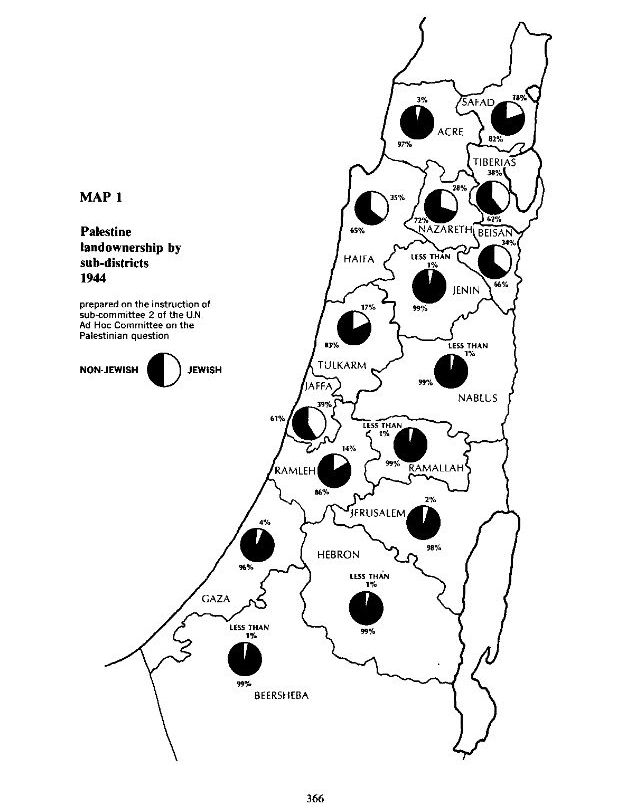
prepared on the instruction of rub-committee 2 of the UN Ad Hoc Committee on the Palestinian question
1981 ALIENATION OF A HOMELAND 367
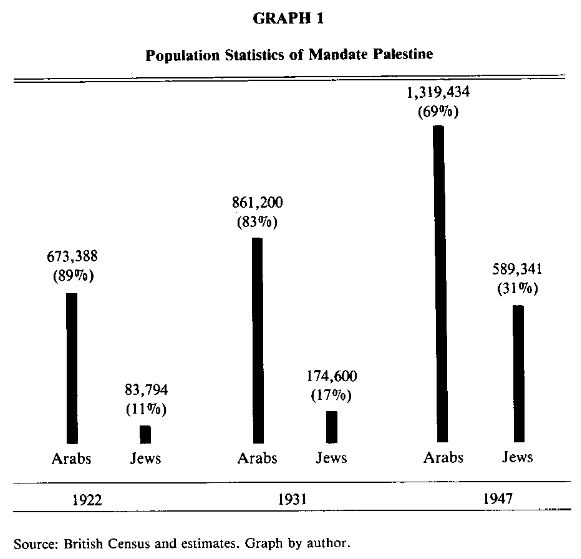
Source: British Census and estimates. Graph by author
TABLE 2
Jewish Landownership
Source of data: Granott, Agrarian Re/orm and rhe Record of Israel, p. 28. (See n. 6, infra.)
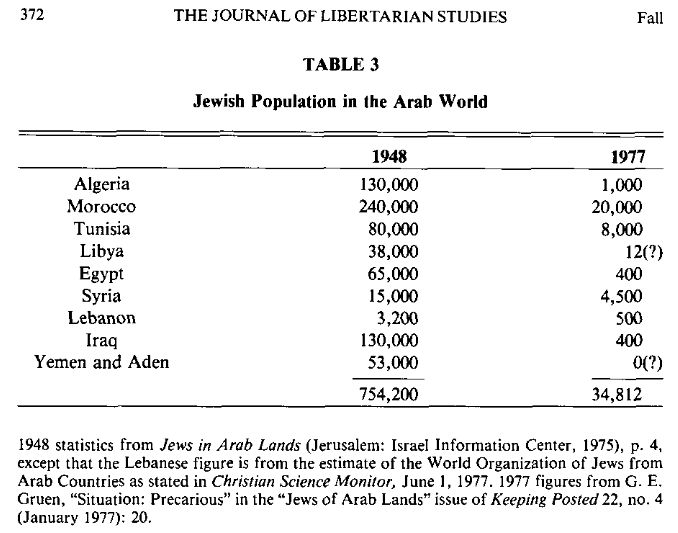
If Zionist colonization resulted in the direct dispossession of the lands of the Palestinian Arabs and the expulsion of three-quarters of a million from their homeland, an indirect result was the expulsion of a like number of Jews from the Arab world. Although since ancient times Moslems and Jews have engaged in oppression and massacres both among and between themselves, the Arab world has been a refuge for Jews from Europe since the Spanish Inquisition, and it received refugees from Hitler long after the United States and Great Britain disallowed Jewish immigration. But particularly in 1948, an upsurge in anti-Jewish riots and government action resulted in numerous deaths, increasingly widespread confiscation of Jewish property, and the emigration of many Arab Jews from their ancient homelands. Of the Arabs who fled Palestine and the Jews who fled the Moslem countries, one commentator stated: "All of the above peoples fled, or were driven from their homes, and few of them were allowed to take with them either money or possessions, or to retain any property rights, however ancient."39 Table 3 indicates the Jewish population in the Arab world in 1948 and 1977. Of the Jews who emigrated, about a half million settled in Israel, while the remainder went to America and Europe.
Although the Arab states bear most of the blame for the oppression or expulsion of the Jews in their midst, a number were driven out not as Jews but as Europeans. In Egypt for decades many riots have been anti-foreigner, as such; e.g., the 1956 crisis, in which all British and French citizens were expelled, including many Jews who were European citizens. Egyptian citizens were not expelled, although some who were Jewish were interned as alleged collaborators. Additionally, of the Jews who left Algeria in the 1960's, 125,000 went to France and only 14,000 to Israel-indicating that they departed as French colons, consequent on the Algerian revolution. While few Jews were in Lebanon in 1948, within a decade 9,000 found refuge in that liberal Arab country, although the recent civil war has driven away people of all ethnic backgrounds. Although the Iraqis carried out oppressive policies against Jews (not to mention larger minorities such as the Kurds), it is known that Zionists exasperated [sic] this process by bombing synagogues and other Jewish centers in Baghdad in 1951, resulting in numerous casualties.40 Such actions add sustenance to the claim that Zionists have always attempted to strain relations between Arab Jews and their homelands.
TABLE 3
Jewish Population in the Arab World
1948 statistics from Jews Arab Lands (Jerusalem: Israel Information Center, 1975), p. 4. except that the Lebanese figure is from the estimate of the World Organization of Jews from Arab Countries as stated in Christian ScienceMonilor, June 1 , 1977. 1977 figures from G . E. Cruen, "Situation: Precarious" in the "Jews of Arab Lands" issue of Keeping Posled22, no. 4 (January 1977): 20.
Notes:
- 1. E. A. Finn, Palestine Peasantry (London: Marshall Brothers, 1923), p. l0.
- 2. Ibid., pp. 11-12.
- 3. Elihu Grant. The People of Palestine (Philadelphia: J. B. Lippincott, 1907 and 1922). pp. 225-2.8.
- 4. A Survey of Palestine: Prepared in December 1945 and January l946 for the information of the Anglo-American Committee of Inquiry (Palestine: Government Printer, 1946, pp. 237-38. Note: l metric dunum = .1 hectare = .247l acre.
- 5. William Polk et al., Backdrop to Tragedy (Boston: Beacon, 1957), p. 235; and Efraim
- Orni, Agrarian Reform and Social Progress in Israel (Jerusalem: Keren Kayemeth Leisrael, 1972), pp. 48 49.
- 6. Orni, Agrarian Reform and Social Progress, p. 5]; Janet Abu-Lughod, "The Demographic Transformation of Palestine," in Ibrahim Abu-Lughod, ed., The Transformation
- of Palestlne (Evanston: Northwestern University Press, 1971], p. l40; Abraham Granott. Agrarian Reform and the Record of Israel (London: Eyre and Spottiswoode, 1956), p. 28; and Survey of Palestine, pp. 114, 372.
- 7. Arie Bober, The Other Israel [Garden City, N.Y.: Doubleday, l972), p. 38.
- 8. Raphael Patai, ed., The Complete Diaries of Theodor Herzl, trans. Harry Zohn (New York: The Herzl Press, 1960), 1:88.
- 9. Orni, Agrarian Reform and Social Progress, pp. 50, 52.
- 10. Census Office of Palestine, Report and General Abstracts of the Census of 1922 (Jerusalem: Greek Convent Press, 1923), pp. 2-4.
- 11. Asia (New York), February 1919, reprinted in R. P. Stevens. ed., Zionism and Palestine Before the Mandate (Beirut: Institute for Palestine Studies, 1972), pp. 79-80.
- 12. Survey of Palestine, pp. 244, 289-94.
- 13. Census of 1922, pp. 3-5. The bedouin population of Beersheba continued to evade the census as a conscription measure and is thus always underestimated. In any case, inclusion of an estimated 72,893 bedouin reduces the proportion of Jews to 10%. The ?gure of 66,553 bedouin was also suggested and carried over in all successive census, including that of the Israelis in November 1948.
- 14. Orni, Agrarian Reform and Social Progress, p. 50.
- 15. Sir John Hope Simpson. Palestine: Report on Immigration, Land Settlement and Development (London: Great Britain Colonial Office, 1930}, pp. 26, 34, 48, 64, 141.
- 16. Ibid., pp. 65-7l, 142.
- 17. Ibid., pp. 56, 73, 134-35, |4|.
- 18. Bober, The Other Israel, p. ll.
- 19. Cited in Simpson, Palestine: Report on Immigration, p. 53.
- 20. Census of Palestine l93l (Jerusalem, 1932), p. xv.
- 21. Shaw Commission Report 1930 (Cmd. .3530), p. 118, cited in Sami Hadawi, ed., Village Statistics 1945 (Beirut: P. L. O. Research Center, 1970), p. 27.
- 22. Abraham Granott, The Land System in Palestine(London: Eyre and Spottiswoode. 1952}, p. 277. Cf. Orni, Agrarian Reform and Social Progress, p. 52.
- 23. Davar (Mapai daily), September 9, 1967, cited in Abdullah Schleifer, The Fall of Jerusalem (New York: Monthly Review Press, 1972], p. 19.
- 24. Survey of Palestine, pp. 238. 267.
- 25. Hadawi, Village Statistics 1945, p. 19. The official Land Valuer of the Mandate Govern ment during 1935-48, Hadawi participated in the compilation of Village Statistics 1945 as originally published by Great Britain.
- 26. Statistical Abstract of Palestine 1944-45 (Jerusalem: Government Printer, 1946), pp. 17, 21.
- 27 General Monthly Bulletin of Current Statistics 12, no. 12 (December 1947):686.
- 28. Granott, Land System in Palestine, p. 278.
- 29. Michael Bar-Zohar, Ben-Gurion: The Armed Prophet [Englewood Cliffs, N.J.: Prentice Hall, 1967), pp. 103, 125, 162.
- 30. Ibid., pp. 107-108. Ironically, about the same number of Jews were killed in 1940 when Irgun and Haganah terrorists bombed the Potria, a ship full of refugees, in Haifa harbor. And in 1948 Begin narrowly escaped death at the hands of Haganah forces led by Yigal Allon and Yitshak Rabin.
- 31. Menachem Begin, The Revoh (Tel Aviv: Hadar, 1964). pp. 162-64.
- 32. Ibid., p. 165.
- 33. Granott, Agrarian Reform and the Record of Israel, pp. 88-89.
- 34. The most thorough legal analysis is provided in Sabri Jiryis, The Arabs in Israel: 1948-1966(Beirut: Institute for Palestine Studies, 1969). chap. 2. The Palestinian attorney has written a new edition published by Monthly Review Press, 1976-relevant chapters are 4 and 5.
- 35. Omi, Agrarian Reform and Social Progress, p. 62; and Granott, Agrarioan Reform and the Record of Israel, pp. 28, 31.
- 36. Statutes passed in 1960 and 1967, cited in Walter Lehn, "The Jewish National Fund," Journal of Palestine Studies 3, no. 4 (Summer 1974):88.
- 37. Abu-Lughod, "Demographic Transformation of Palestine," p. 162.
- 38. Dr. Israel Shahak, Chairman of the Israeli League for Human and Civil Rights, Report on Arab Villages Destroyed in Israel (Tel Aviv, February 15, 1973). Dr. Shahak estimated that out of 120,000 bedouin in pre-1948 Beersheba. 25,000 remained.
- 39. Martin Gilbert, The Jews of Arab Londs (London: World Organization of Jews from Arab Countries. 1976). Map 14.
- 40. Jerusalem Post, June IS, 16 and July 21, 1966, cited in I. M. Oweiss, TheIsraeli Economy (Washington, D.C.: Georgetown University, 1974), p. 20.
1. Genetic studies have proven that the logical deduction i.e. the Zionist Jews and the 'Arab' Palestinians both share a Caanaanite genetic heritage is correct.
2. the Ottoman Empire did not consider the Palestinian fellaheen (peasants) to be the legal owners of the land they cultivated. The state viewed most agricultural land as miri (state-owned land belonging to the Sultan), while the peasants held conditional usufruct (cultivation and possession) rights tied to paying taxes.
3. Jews have never oppressed or massacred Muslims. Since the time of Muhammed they have been legislated as 'dhimmis' third class citizens in Muslim lands under financial and social oppression which has often broken out into massacres of Jews only.
4. At least 600,000 expelled Mizrahi Jews went to Israel.
5. the source for this information is either "Mein Kampf" or "The Protocols of the Elders of Zion"