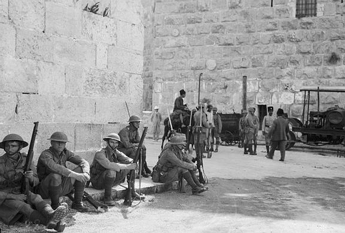
The Haram al-Sharif or the Noble Sanctuary is a major religious site in Jerusalem's Old City. Sacred to Muslims, it contains the Al-Aqsa Mosque and the Dome of the Rock and is basically a testament in land to the conquest of Palestine by Islam in the 7th century and a shrine to their lording it over the Jews and the Christians who in Sharia Law are dhimmis, second class people who must accept their "protection" by Muslims and pay the Jizya tax for their humiliation. Since the conquest of Palestine by the British the local Muslims have been extremely touchy about any "violation" of its holiness by non-Muslims. Throughout the Ottoman Empire and the British Mandate mobs of Arabs would run amok at any provocation of the site (real or imagined orannounced in mosques). "Excessive" Jewish prayer at the foot of Buraq Wall was enough to start rioting.
1920s: The British Mandate over Palestine
The history of British Mandate Paletine is being rewritten as a growing national 'resistance' to British imperialism and Zionist settler-colonialism. However there was no unified Arab Palestine society which had a very small, rich clerical-legal-landowner-merchant-moneylending elite (the a'yan or effendis) controlling a very large, very poor, perpetually indebted fellaheen peasant majority whose situation had been worsening for nearly a century in a near feudal society. The Ottomans and the a'yan had exhibited no interest in improving the fellaheen's situation. Unfortunately the British administration's actions were often counter-productive and the policy of financial frugality meant there was no possibility to ameliorate the poverty of the fellaheen except by providing some day-labour work.
The fellaheen had a history of non-compliance with the law. They resisted paying taxes, they avoided being identified by government, they pursued blood feuds, they robbed travellers where possible and attacked Jews and Christians when religious emotions flared. Legal title to their lands had mostly passed to the elites because of this non-compliance. They had suffered through the destruction and severe economic disruptions caused by World War I, only to endure prolonged economic 'depression' in its aftermath.1
… the most influential factor affecting land purchase priorities for the JNF in Palestine was the Arab community's stratified social structure. Due to a weak Ottoman central government and the evolution of local clan and family power in Palestine, large areas of land became the possession of relatively few individual landowners. Vast land-holdings, in amounts exceeding five thousand dunams or more, were accumulated in large part owing to fellaheen indebtedness. This was mostly caused by poor crop yields and unproductive methods of land use. Merchants, rural shaykhs and notables, and urban professionals gradually amassed areas of land as financial investments. In many cases, individual fellaheen who once worked their village lands as independent landowners became tenants of large landowners in the same land area. Many of these large landowners also dominated local politics in the sub-districts of Palestine and later formed a nucleus in the Palestinian Arab nationalist movement. For a variety of reasons, the JNF's preference was to purchase large areas of land from as few Arab landowners as possible. - K.W. Stein
On July 1st 1920 the post-World War I military government of Palestine, known as the Occupied Enemy Territory Administration (OETA), officially ceasedi. It was formally replaced by a British civil administration under High Commissioner Sir Herbert Samuel. The British administration brought a new element to Palestine, the rule of law, or at least attempts to enforce the rule of law. Unfortunately the Palestine Police Force had only 1,200 to 1,500 personnel, some British officers over mostly Arab policemen with some Jews. The Arab police often joined in the riots rather than enforce the law. As virtually all Arab-Jewish crime and violence was initiated by the Arabs they saw the British as unfairly supporting the Jews.
On arrival in 1920, British High Commissioner, Herbert Samuel pardoned Hajj Amin al-Husseini and the others convicted of crimes in the 1920 riots. On May 8th, 1921 Samuel appointed al-Husseini as the Mufti of Jerusalem. In 1922 the Supreme Muslim Council was established giving him control over religious courts, schools, and lucrative religious funds (awqaf). He accepted the title of Grand Mufti.
There were 83,794 Jews living in Palestine. Did the Mufti and the notables think they could eliminate the Jews by occasionally getting mobs of Muslims to run amok with clubs and knives and kill a few score Jews here and there. That this would force the most powerful state in the world to ship them elsewhere? Apparently so, as this was their modus operandi for the next 15 years: violence and complaints about justice for themselves, the natural rulers. The provided no justice for the fellaheen.
March 1, 1920: A large group of armed Shi'ite militiamen and Bedouins from the village of Al-Khalisa demanded entry to the kibbutz Tel Hai. Entry was refused. Shots were fired, prompting Joseph Trumpeldor and reinforcements from nearby Kfar Giladi to come to their aid. Five Arabs and eight Jewish settlers were killed. Trumpeldor was severely wounded in the stomach and later died.
During the nineteenth century the musha'a was the typical system of land tenure in Palestine. Towards the end of the century and during the twentieth the process of division of the musha'a lands among individual peasants began, yet in 1923 a special government commission found that 56 percent of the village lands it investigated (which comprised nearly the total land of the country) was still musha'a. … In general a household which owns less than one feddan is considered poor, a household owning 1-2 feddans middle, and a household owning 2 or more well-to-do. According to the above table therefore, of all the Arab land cultivators, 69.7 percent belongs to the rural poor, 13.9 percent are middle peasants and 16.4 percent make up the village bourgeoisie. - T. Cliff
Note the way Kalidi hides the reality: Zionists were buying land freely offered by the Arab owners and were legally immigrating. How is this an offence?
In literal terms, the Zionists were steadily changing Arab-owned land into Jewish-owned land and steadily increasing the Jewish population.* The Arabs were on the defensive against this continual movement. There could hardly be a case to which the word "defensive" applies more exactly. Yet by the nature of things, Parliament and the public in England only became conscious of what was going on when the peaceful and officially-supported growth of Jewish lands and population aroused violent opposition from the Arabs. The initiative in firing the first shot must always lie with the Arabs, and this would be an "offensive" action. - From Haven to Conquest - Walid Khalidi
Between 1921 and 1925 various Jewish land organizations made large purchases by auction of areas in the Vale of Esdraelon. The area in question amounted to rather more than 200,000 dunoms. Twenty-two villages were included in the sales … the cultivators had no written agreement with the landlord to whom they paid annually one-fifth of the produce of the land.
We think that the Jewish companies are not open to any criticism in respect of these transactions. In paying compensation, as they undoubtedly did, to many of the cultivators of lands which they purchased in the Plain of Esdraelon, those companies were making a payment which at the time of the transactions the law of Palestine did not require. Moreover, they were acting with the knowledge of the Government. - Shaw Commission Report
Saleh in "The Palestinian Issue" refers to mob attacks as 'uprisings' to infer they were political in nature. It's accepted by historians that the persecution of Jews by Muslims was less than that by Christians but there is a documented history of sporadic attacks by Muslim mobs on Jewish communities throughout the Islamic empires. In Mandate Palestine these did not warrant the term 'uprisings' as they did not attack the British officials and the British Mandate administrators did not recognise them as such. They were usually called 'riots.' They were mostly begun by the notables ordering speeches be made at mosques claiming the Jews were trying to take control of the Haram al-Sharif or pray at the Al-Buraq wall in Jerusalem or something similar.
Since the 1970s discussion of the Palestinian - Israeli situation has accepted the facts on the ground and has evolved to attempts to prove that Zionism was evil from the beginning, that Israel is a Colonial Settler Society based on the Original Sin of expelling the inhabitants by superior force and guile. The arguments use passive voice whenever discussing violence and murder by the Palestinians e.g. "in 1921 violence broke out in Hebron," "in 1948 warfare commenced," On April 4, 1920, "the Nebi Musa celebration turned violent" around the Old City of Jerusalem, and Arabs and Jews were killed and injured. The journalist Aref Al-Aref, Hajj Amin al-Husseini who at the time had no official position, and Omar al-Barghouti of the Muslim-Christian Association were charged with inciting violence, convicted and later pardoned.
The Palestinian Issue: Historical Background & Contemporary Developments - Dr Mohsed Mohammed Saleh, Al-Zayouna Centre
 The uprising of al-Quds or Mawsim al-Nabi Musa (Prophet Moses Season) took place on 4-10/4/1920 in Jerusalem (five Jews were killed and 211 were injured, compared to four Arabs were killed and 24 injured)
Wikipedia: "The riots coincided with and are named after the Nebi Musa festival, which was held every year on Easter Sunday. Arab religious leaders gave speeches during the festival (in which large numbers of Muslims traditionally gathered for a religious procession) that included slogans referencing Zionist immigration and previous confrontations over outlying Jewish villages in the Galilee. On Monday, as disturbances grew worse, the Old City was sealed off by British authorities and no one was allowed to exit the area. Martial law was declared, but looting, burglary, rape, and murder continued. Several homes were set on fire, and tombstones were shattered. British forces found that the majority of illicit weapons were concealed on the bodies of Arab women"
June 1920: Following the Nabi Musa riots and the failure of British law enforcement, the Haganah was formed. Another bar in the iron cage.
The Jaffa Uprising erupted between 1-15/5/1921 and included parts of northern Palestine (47 Jews were killed and 146 were injured, while 48 Arabs were killed and 73 injured).
Wikipedia: "Dozens of British, Arab, and Jewish witnesses all reported that Arab men bearing clubs, knives, swords, and some pistols broke into Jewish buildings and murdered their inhabitants, while women followed to loot. They attacked Jewish pedestrians and destroyed Jewish homes and stores. They beat and killed Jews in their homes, including children, and in some cases split open the victims' skulls … At 1:30 pm, an immigrant hostel run by the Zionist Commission and home to a hundred people who had arrived in recent weeks and days was attacked by the mob … A fourteen-year-old girl and some men managed to escape the building, but each was in turn chased down and beaten to death with iron rods or wooden boards"
Most of the Jewish deaths and injuries in these three uprisings were caused by the Arabs, while most of the Arab deaths and injuries were inflicted by the British troops and the British police. Haj Amin al-Hussaini, the mufti of Jerusalem, secretly played a prominent role in both al-Quds and al-Buraq Uprisings.
Winston Churchill, then Colonial Secretary, was in Cairo at the time trying to solve such problems and policy in the Middle East at the Cairo Conference. To this day there is considerable dispute about his role.
from A Peace to End All Peace by David Fromkin
Churchill further attempted to allay Arab suspicions by demonstrating that their economic fears were groundless. Jewish immigrants, he argued repeatedly, would not seize Arab jobs or Arab land. On the contrary, he said, Jewish immigrants would create new jobs and new wealth that would benefit the whole community.
In June 1921 Churchill told the House of Commons that "There really is nothing for the Arabs to be frightened about … No Jew will be brought in beyond the number who can be provided for by the expanding wealth and development of the resources of the country." 11 In August he repeated to an Arab delegation that had come to London that I have told you again and again that the Jews will not be allowed to come into the country except insofar as they build up the means for their livelihood … They cannot take any man's lands. They cannot dispossess any man of his rights or his property … If they like to buy people's land and people like to sell it to them, and if they like to develop and cultivate regions now barren and make them fertile, then they have the right … [to do so]. 12 "There is room for all …," he told them. 13 "No one has harmed you … The Jews have a far more difficult task than you. You only have to enjoy your own possession; but they have to try to create out of the wilderness, out of the barren places, a livelihood for the people they bring in." 14 In the same statement he complained to the Arabs that it was not fair of them to refuse to negotiate: "it is not fair to come to a discussion thinking that one side has to give nothing and the other side has to give large and important concessions, and without any security that these concessions will be a means of peace."
In June 1921 Churchill told the House of Commons that "There really is nothing for the Arabs to be frightened about … No Jew will be brought in beyond the number who can be provided for by the expanding wealth and development of the resources of the country." 11 In August he repeated to an Arab delegation that had come to London that I have told you again and again that the Jews will not be allowed to come into the country except insofar as they build up the means for their livelihood … They cannot take any man's lands. They cannot dispossess any man of his rights or his property … If they like to buy people's land and people like to sell it to them, and if they like to develop and cultivate regions now barren and make them fertile, then they have the right … [to do so]. 12 "There is room for all …," he told them. 13 "No one has harmed you … The Jews have a far more difficult task than you. You only have to enjoy your own possession; but they have to try to create out of the wilderness, out of the barren places, a livelihood for the people they bring in." 14 In the same statement he complained to the Arabs that it was not fair of them to refuse to negotiate: "it is not fair to come to a discussion thinking that one side has to give nothing and the other side has to give large and important concessions, and without any security that these concessions will be a means of peace."
The Haycraft Commission Report 1921
"… we have no doubt that the Arabs were the first to turn this quarrel into a race conflict, and, when once this issue was joined, they behaved with a savagery which cannot be condoned. Dr. Beadles, the Principal Medical Officer, Jaffa, thus speaks of his examination of the dead bodies on the 1st May: "I was struck most with the number of wounds on each body, and the ferocity of the wounds. I am speaking particularly of broken skulls. Some of the victims had dozens of wounds"
"In none of these five cases can the conduct of the Arabs be excused or condoned. Most of the colonists had lived for years on quite friendly terms with their Arab neighbours, and had in many cases given them regular employment on a large scale. The bloodthirsty attacks on these peaceful settlements, which had been guilty of no provocation whatever, are among the worst features of the disturbances."
"As in most countries, the desire for loot appears to have asserted itself strongly immediately the position got out of hand. Looting was carried out in Jaffa and Menshich on an extensive scale on Sunday and Monday, the 1st and 2nd May, but the looters appear to have been restricted to the poorer and more ignorant elements of the community. The looters were almost exclusively Arabs, the victims almost exclusively Jews.
Palin Commission Report 1921
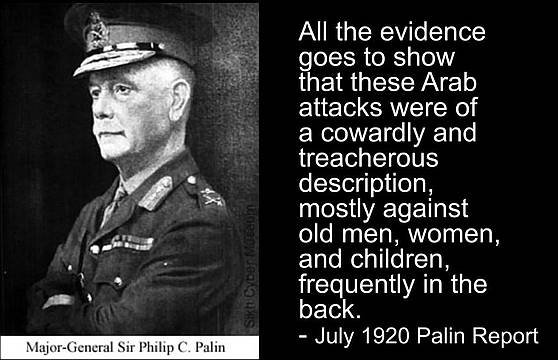
The Palin Commission that investigated the attacks of 1920 was explicit: "But it is perfectly clear that with these few exceptions the Jews were the sufferers, and were, moreover, the victims of a peculiarly brutal and cowardly attack, the majority of the casualties being old men, women and children."
From these figures it is clear that the incidence of the attack was against the Jews and that the attack against them was made in customary mob fashion with sticks, stones and knives. All the evidence goes to show that these attacks were of a cowardly and treacherous description, mostly against old men, women and children and frequently in the back. The total retaliatory efforts of the Jews and the Military Authorities resulted in only 25 recorded casualties.
In addition, 5 Christians (two wounded by firearms) and 7 soldiers are reported wounded - all apparently at the hands of the Arab mob.
It is interesting to add that no attack was made at any time against the officers and men of the British regiment, nor were British officers molested if we except
one or two attempts at rescue of prisoners: the attack was entirely directed against the Jews.
A 1922 census revealed that a third of the Arab farmers were fellahin-tenant sharecroppers-whose average plot rarely exceeded 100 dunams (25 acres). Endlessly indebted to their landlords, to whom they paid a rent of from 33 to 50 percent of their crops, they lived with their families of five or more children in mud-brick huts, possessed virtually no sanitary facilities, and suffered chronically from amoebic dysentery and bilharziasis. Submarginal as these conditions were, they were immeasurably better than those of Moslem Arabs elsewhere in the Middle East. The statistics of Arab population growth were revealing: in Palestine the increase between 1922 and 1946 was 118 percent, a rate of almost 5 percent annually, and the highest in the Arab world except for Egypt. It was not all natural increase. During those twenty-four years approximately 100,000 Arabs entered the country from neighboring lands. The influx could be traced in some measure to the orderly government provided by the British; but far more, certainly, to the economic opportunities made possible by Jewish settlement. The rise of the Yishuv benefited Arab life indirectly, by disproportionate Jewish contributions to government revenues, and thereby to increased mandatory expenditures in the Arab sector; and directly, by opening new markets for Arab produce and (until the civil war of 1936) new employment opportunities for Arab labor. It was significant, for example, that the movement of Arabs within Palestine itself was largely to regions of Jewish concentration. Thus, Arab population increase during the 1930s was 87 percent in Haifa, 61 percent in Jaffa, 37 percent in Jerusalem. A similar growth was registered in Arab towns located near Jewish agricultural villages. The 25 percent rise of Arab participation in industry could be traced exclusively to the needs of the large Jewish immigration. - A History of Israel Howard M. Sachar
The winter of 1925-26 saw the lowest recorded rainfall over Jerusalem. Combined with the recent huge increase in the population the drought caused Solomon's Pools, Jerusalem's chief reservoir, to run dry by early summer. The rainwater cisterns beneath houses were all empty. The government requisitioned the spring water of a local Arab village renowned for its market gardens bankrupting the villagers while still allowing Jewish construction workers all the water they needed to mix concrete for the many new Jewish immigrants. The Arab market gardeners whose water had been taken went bankrupt and in the old city, even with the requisition of water, residents had to queue for hours to fetch water from the public taps during the limited hours they were turned on. The Police prepared for riots but the Arabs, this time, preferred to fight their battles in the courts rather than on the ground. The Negev too was badly hit and the Bedouin there moved their herds to Northern Palestine where they came into conflict with the new Jewish agricultural settlements. The police took too long to come to the aid of settlers. They relied on their own Watchmen.
The next winter (1926-1927) was completely different. The first rains arriving in Haifa, Jaffa and Jerusalem on October 5th. Severe storms in November struck Jaffa hardest causing sailors on anchored ships t to be swept overboard and drowned and other steamers to bypass Jaffa and head for Haifa which too suffered storm damage. By the middle of December, cisterns in Jerusalem were halfway full, and still it did not stop raining. Storms struck again in February. A steamer, The Lord Byron, was blown inshore at Jaffa and remained grounded for many days. Several members of the British section of Police received official commendations for keeping in contact with the crew while it was stranded. Much of Palestine, from Jerusalem northwards was blanketed in snow for four days. In May a spell of extraordinary hot weather was followed by a return to wintry conditions. British Palestine Police website
December 6 1928: High Commissioner Sir John Chancellor takes office. Chancellor quickly became a strong opponent of the Zionist program but instead of al-Husayni working with him he incited the al-Buraq riots by spreading the claims that the Jews were attempting to sieze al-Aqsa.
The Palestinian Issue: Historical Background & Contemporary Developments - Dr Mohsed Mohammed Saleh, Al-Zayouna Centre
The al-Buraq Uprising lasted from 15th August until 2nd September 1929 and erupted due to the dispute over al-Buraq Wall (The Western Wall of the al-Aqsa Mosque) which the Muslims were defending against Jewish Zionist claims and aggressive attitude. The uprising spread all over Palestine, where 133 Jews were killed and 339 were injured, and 116 Arabs were killed and 232 were injured. Wikipedia: As a result of Arab rioting throughout Palestine, the British established a Commission of Inquiry whose purpose was to determine the cause of the rioting. The Shaw Commission found that the violence occurred due to "racial animosity on the part of the Arabs, consequent upon the disappointment of their political and national aspirations and fear for their economic future."
The Shaw Commission report noted the presence of "landless and discontented" groups of Arabs that were growing as a result of the Yishuv. It cited Jewish immigration and land purchases as the sources of Arab discontent and recommended closer British regulation in these areas. However the Jewish population was predominantly urban: almost three-quarters of the 83,794 Jews lived in the urban areas in or around Jerusalem, Jaffa and Tel Aviv. About 20,000 Jews resided in the north, including 6,000 in Haifa. Conversely, the Arab population was predominantly rural in the West Bank highlands. From where was the discontent rising?
Shaw Commission Report on the al-Buraq / Western Wall Disturbances / Hebron Massacre of August, 1929
On the 1st of September Sir John Chancellor, the High Commissioner issued the following Proclamation:- "I have returned from the United Kingdom to find to my distress the country in a state of disorder and a prey to unlawful violence. I have learned with horror of the atrocious acts committed by bodies of ruthless and blood-thirsty evil-doers, of savage murders perpetrated upon defenceless members of the Jewish, population regardless of age or sex, accompanied, as at Hebron, by acts of unspeakable savagery, of the burning of farms and houses in town and country and of the looting and destruction of property. These crimes have brought upon their authors the execration of all civilized peoples throughout the world."
"About 9 o'clock on the morning of the 24th of August, Arabs in Hebron made a most ferocious attack on the Jewish ghetto and on isolated Jewish houses lying outside the crowded quarters of the town. More than 60 Jews - including many women and children - were murdered and more than 50 were wounded. This savage attack, of which no condemnation could be too severe, was accompanied by wanton destruction and looting. Jewish Synagogues were desecrated, a Jewish hospital, which had provided treatment for Arabs, was attacked and ransacked, and only the exceptional personal courage displayed by Mr.Cafferata - the one British Police Officer in the town - prevented the outbreak from developing into a general massacre of the Jews in Hebron. - Shaw Report p.64"
The "Wailing Wall" Riots (1929) As A Watershed In The Palestine Conflict - Avraham Sela
the 1929 crisis - though sparked by the Wailing Wall affair - essentially resulted from factional struggle for power within the Arab-Palestinian community, combined with a growing anxiety at the recovery of the Zionist movement after a few years of decline. The internal struggle was aggravated by the prospect of establishing a Legislative Council (LC), and ultimately brought about its failure. Whether or not there was a real chance for establishing a LC, the lack of any constitutional development played into the
hands of the Yishuv (Jewish community in Palestine) which had been already in an advanced state of social and political institutionalization.
Palestinian Political Action Against the Zionists
Zionists focused on building infrastructure and security for a future Jewish national home. The Palestine Zionist Executive (Jewish Agency) to liaise with the Mandate government; the Histadrut labor federation formed and established a cooperative movement; the Keren Hayesod (Foundation Fund) to fund immigration, settlement, and economic development; the Haganah an underground Jewish defense force to protect against Arab riots. The began to construct an alternative, segregated, autonomous Jewish economic and social structure. Only Jewish workers were to be hired, they acquired land for exclusive Jewish settlements, established Kibbutzim agricultural cooperatives, created autonomous health, education, and defense structures parallel to, but separate from the Mandate governments.
The Palestinians formed political parties (controlled by different a'yan families), had congresses, complained to the British government, refused to interact with Mandate commissions, continued small scale attacks on Jews. The al-Hussaini and al-Nashashibi families fought over leadership of the Palestine which was still basically feudal with patron-client relationships. The Grand Mufti, Hajj Amin al Husseini was the éminence grise promoting violence and a policy of complete rejection of compromise through his domination of politics and the Islamic Sharia religious-legal-financial (Waqf) establishment.
There are 83,794 Jews living in Palestine. Does Hajj Amin al-Husseini think he can eliminate them by mobs of Muslims running amok with sticks and knives or does he think killing a few hundred here and there will force the British, still the most powerful navy in the world, to ship them elsewhere?
Mohmsen Mohammed Saleh: 483,000 Jews migrated to Palestine during the British Mandate period and by 1948 they were 646,000 (31.7% of the population) and controlled 6% of the land holding 291 settlements. All the land the Jews purchased was sold by Arabs or Ottomans. Every large landowner knew he was making his tenants, the long-term clients of his family, landless. The fellaheen had already been steadily losing "their" land due to debt, drought and poor farming practices. The patron-tenant relationship was a one-way power relationship.
At the end of the British Mandate period only 25% of the land was registered for private ownership
- 12% of the land was owned by Palestinian Arabs
- 7.5% of the land was owned by Jews
Notes
- 1 Quoted in 'Will the Real Palestine Peasantry Please Sit Down' - Charles Anderson: Report of the High Commissioner on the Administration of Palestine, 1920-1925, pp. 4, 7, 18. On the effects of World War I, see Bernard Wasserstein, The British in Palestine: The Mandatory Government and Arab-Jewish Conflict, 1917-1929 (Oxford: Blackwell Publishers, 1991 (1978)), p. 2; Bayan Nuwayhid al-Hut, al-Qiyadat wa-l-mu'assasat al-siyasiyyah i Filastin, 1917-1948 (Acre: Dar al-Aswar, 1981), pp. 55-56.
References
- The Jewish National Fund: Land Purchase Methods And Priorities, 1924-1939 - Kenneth W. Stein
- The Palestinian Issue - Mohsen Mohammad Saleh