The 1948 Israeli War of Independence
Very few of the fellaheen (1%) actually fought in the 1936 Revolt and casualties were high. The fellaheen flight of 1948 (the Nakba) should have been no surprise.
One Palestinian author had the chutzpah to complain that the British Army hadn't trained any Arabs to fight during WW2 as if they should train soldiers so they could fight for the Nazis. Walid Khalidi explains the situation facing the Arabs after the war: "Palestinian Arab military strength had been shattered by the British during 1936-39, and partly from the immense development in the Zionist military establishment during World War II. This development took place on several levels. A total of 27,028 Palestinian Jews were recruited by the British Army (1,106 in the Royal Navy, 2,652 in the RAF and 23,270 in the Army)."
1947: There are 630,000 Jews living in Palestine.
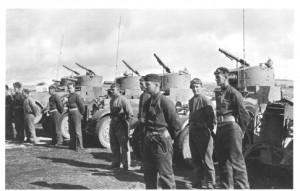 February 1947: The British government was sick of the cost of maintaining "peace" in Palestine and offloaded the problem onto the U.N. November 30 1947: partition of the area into 2 countries was decided upon despite unanimous rejection by all Muslim countries. December 2 1947: A general strike was declared by the Arab High Committee and fighting broke out ie.. Before the British Army evacuated, Palestinian Arabs supported by the "Arab Liberation Army" began attacks on the Jewish population.
The major difference between the Jewish and Arab forces was that nearly every able-bodied Israeli male became part of the army while very few Palestinian men fought in the conflict. In 1947/8 it was generally considered that the Jews would be defeated, if not by the Palestinians, then by the armies of the Arab League which had publicly announced their determination that the Arab army invasions would be "a war of extermination and a momentous massacre which will be spoken of like the Mongolian massacres and the Crusades." Was this threat actually made: Barnett and Karsh - Yes and Brendan McKay, with help from Talaat: No. You be the judge.
 November 19 1947: King Abdullah asked Golda Meyerson (Meir), whether the Jewish forces would act to thwart a Jordanian military
incursion into Palestine. Meyerson 'said she was hoping for a [UN] resolution that would establish two states, one Jewish and one Arab'. Meyerson repled that the Jews:
would view such an attempt in a favorable light, especially if he did not interfere with the establishment of their state and avoided a
clash between his forces and theirs and, secondly, if he could declare that his sole purpose was to maintain law and order until the UN could establish a government in that area.
November 19 1947: King Abdullah asked Golda Meyerson (Meir), whether the Jewish forces would act to thwart a Jordanian military
incursion into Palestine. Meyerson 'said she was hoping for a [UN] resolution that would establish two states, one Jewish and one Arab'. Meyerson repled that the Jews:
would view such an attempt in a favorable light, especially if he did not interfere with the establishment of their state and avoided a
clash between his forces and theirs and, secondly, if he could declare that his sole purpose was to maintain law and order until the UN could establish a government in that area.
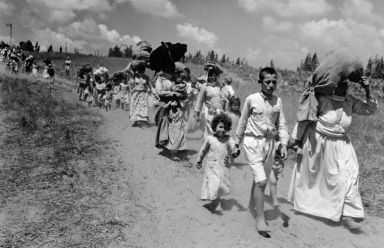
- December 1947: the British High Commissioner, Sir Alan Cunningham reported "Arabs are leaving the country with their families in considerable numbers, and there is an exodus from the mixed towns to the rural Arab centers." A month later he reported that the "panic of [the] middle class persists and there is a steady exodus of those who can afford to leave the country."
- An estimated 30,000 Palestinian Arabs evacuated Jerusalem, Haifa and some villages near the Mediterranean coast between January and March 1948. - Jerusalem 1948 - ed. Salim Tamari
- March 8 1948: Haj Amin Husseini noted in a letter to the governments of Syria, Egypt and Lebanon the tendency "of a great number of Palestine's sons to leave their cities and settle in neighboring Arab countries." The Arab Higher Committee, he declared, had decided that no one would be allowed to leave Palestine without its approval. "The numerous Palestinians who have left their country since the start of fighting," he wrote, were to be compelled "in the national interest" to return. He requested the three governments to refuse to extend their residence permits and to refuse to issue new ones without his committee's consent. - O Jerusalem, Larry Collins
December 1947 to April 1948: Infiltration of Palestine begins. Separate Hagana and British intelligence reports indicated that from December 1947 to April 1948, 9,000 men had entered Palestine, 4,000 of whom were Qawukji's men. The infiltrators crossed the border from Lebanon, Jordan and Syria. They were of Palestinian, Syrian, Lebanese, Iraqi,Jordanian, Sudanese and Egyptian nationalities and they were positioned in various places around the country.48 One hundred volunteers came from Yugoslavia, and were sent to Jaffa and Jerusalem. Some 200 combatants were stationed in Jaffa under the direct command of an Iraqi officer, 'Adel Najm al-Din. Others, including 500 Bosnian Moslems,49 joined the forces of 'Abd al-Qa-dir al-Husayni and Hasan Salama forces. - War in Palestine 1948 - David Tal
8th April 1948: Qadir al-Husayni was killed in combat on April 8, 1948 while leading a counter-attack on al-Qastel village near Jerusalem. Thousands of mourners attended the massive but very short funeral procession from the Dome of the Rock to al-Aqsa Mosque leaving al-Kastel undefended and it was retaken by the Jews.
9th April 1948: The overwhelming majority of the Jews of Palestine reacted to Deir Yassin with shock and abhorrence. The Jewish Agency immediately disassociated itself from the terrorists' act and roundly condemned it. David Ben-Gurion personally cabled his shock at the incident to King Abdullah. The Chief Rabbi of Jerusalem took the extraordinary step of excommunicating the participants in the attack. It was the Arabs, however, who had the obligation to announce the tragedy to the world. For hours, Hazem Nusseibi and Hussein Khalidi, secretary of Jerusalem's Arab Higher Committee, agonized over how to present the news. "We were afraid the Arab armies for all their talk weren't really going to come," Nusseibi later recalled. "We wanted to shock the population of the Arab countries into bringing pressure on their governments." And so they decided to broadcast the news of Deir Yassin in all its horror. It was, as Nusseibi would one day admit, "a fatal error." The gruesomely detailed news did not change any minds in the council of the Arab governments. But it stirred a growing sense of panic among the Arabs of Palestine. By their unhappy error of judgment, the Arab propagandists too had unwittingly helped set the stage for a problem soon to haunt the Middle East, the drama of thousands of Arab refugees. - O Jerusalem, Larry Collins
May 4 1948: the Brisbane Courier-Mail reported that "Arab invasion plans are complete, the Daily Telegraph's special correspondent at Amman writes: 'Arab ministers and other leaders have now attained unity,' and the ascendancy of King Abdullah of Transjordan seems assured. 'An offer to the Jews of citizenship in a unified Palestine with local autonomy in Jewish majority areas is the Arabs' final word. 'If it is rejected full-scale war involving the regular forces of all the Arab States is inevitable. But there will be no penetration until the British mandate expires on May 15."
Palestine became an enormous black market in British arms and equipment which helped when Israel was invaded by armies commanded (the Arab Legion) or equipped by Britain.
With the benefit of hindsight, it is now common to say that the victory for the Jews was assured even if 1% of the Jewish population had to die in the process but by the the 28th May the Jewish quarter of Jerusalem had to surrender to the Jordanian Legion. Major Jewish Defeats of May 15-28 included:
- Fall of Gush Etzion (May 12-14): Just prior to independence, the strategically vital bloc of four kibbutzim south of Jerusalem was overwhelmed by the Arab Legion and local Arab forces. The defenders surrendered, followed by a massacre of many by local irregulars.
- Surrender of the Old City Jewish Quarter (May 28): After two weeks of intense battle, the outgunned defenders in Jerusalem's Old City surrendered to the Jordanian Arab Legion. The Jewish residents were forced to evacuate, losing control of the area for the first time in modern history.
- Destruction of Convoys at Bab el-Wad including the medico massacre at Shaykh Jarra-h: The Arabs successfully blocked the main highway to Jerusalem, destroying numerous supply convoys and forcing the Haganah to abandon efforts to supply the city through that route, leaving New Jerusalem under siege.
On May 14, 1948, David Ben-Gurion, the head of the Jewish Agency, proclaimed the establishment of the State of Israel.
When war broke out in 1948 and Jerusalem fell under siege, Dov Yosef was appointed the city's governor general. With supplies dwindling and hunger creeping in, he controlled the rationing of food, gasoline, and other necessities. By June 7, there was only three days of food left in his warehouses in Jerusalem and with no convoys getting through. Jerusalem could only be saved by a cease-fire that allowed resupply of the city.
…On Monday morning, June 7, Bernadotte had submitted to the Arab League and Tel Aviv a new truce plan.
Ben-Gurion felt he had no choice but to accept. There was no doubt in his mind that "we were at the end of our rope." Supplies "were running out everywhere." They had suffered two defeats at Latrun, lost the Old City and suffered what would have been a serious defeat against the Iraqis in Jenin if their enemies had pursued it. The Egyptians were twenty-five miles from Tel Aviv. Only in the north, where they had captured Acre, driven to the Lebanese border and chased the Syrians out of Galilee, had they been successful. Everywhere their units needed time to regroup, reorganize and reequip. And above everything else loomed the problem of Jerusalem. Despite the heroic efforts of Marcus' road builders and his porters, Ben- Gurion had a growing fear that "the Arabs were going to get Jerusalem." Hoping his foes would do the same, he cabled his acceptance of the plan to Bernadotte. - O Jerusalem - Larry Collins
June 30, 1948: the last remaining British military units departed from the port of Haifa.
1948: There are 716,700 Jews living in Israel and 156,000 Muslims living in Israel. Solving the Palestinian "Jewish problem" with violence has proven to be a Nakba. It really is time to try another path. Could things possibly get worse for them if the Palestinians and Muslim countries continue with violence?
1955: Thanks to the Muslim governments deporting up to 900,000 Middle Eastern Jews from their homelands there are now 1,590,500 Jews living in Israel. Is this a deliberate attempt to make Israel militarily stronger?
- Britain and the Arab-Israeli War of 1948 - Avi Shlaim 1987 sensible
- Collusion Across the Jordan - Avi Shlaim 1988 paranoid
- Israel and the Arab Coalition in 1948 - Avi Shlaim
- 1948: The First Arab-Israeli War - Benny Morris
- 1948-05-15 Arab League Statement
- A Soldier with the Arabs - Sir John Bagot Glubb
- Al-Nakba and its Many Meanings - Adel Manna
- Arab League Declaration on the Invasion of Palestine May 15, 1948
- Britain and the Arab-Israeli War 1948 - Avi Shlaim
- British Officials Predicted War And Arab Defeat In Palestine In 1948 - The Guardian
- Charging Israel With Original Sin - Shabatai Teveth
- Collusion Across the Jordan - Avi Shlaim
- Explaining Transfer: Zionist Thinking and the Creation of the Palestinian Refugee Problem - Benny Morris
- How Many Palestinian Arab Refugees Were There - Efraim Karsh
- Israel's Wars, 1947-93 - Ahron Bregman
- Jerusalem 1948: - ed. Salim Tamari
- Nazi Palestine: The Plans for the Extermination of the Jews in Palestine - Klaus-Michael Mallmann
- Nazi Roots of Palestinian 'Resistance'
- O Jerusalem! - Larry Collins (Review - John Dixon)
- Palestine 1947-Israel 1948 - Ivor Wilks
- Palestine 1948 War Escape and th- Emergence of the Palestinian Refugee Problem - Yoav Gelber
- Palestinians and 1948 - Rashid Khalidi
- The 1948 Ethnic Cleansing of Palestine - Ilan Pappé
- The Arab-Israeli Conflict: The Palestine War 1948 - Efraim Karsh
- The Arab States and the 1948 War in Palestine - Michael Eppel
- The Debate About 1948 - Avi Shlaim
- The Historiography of the 1948 War in Palestine: The Missing Dimension - David Tal
- The Meaning of the Disaster - Constantine K. Zurayk
- The Story of the Arab Legion - Sir John Bagot Glubb
- The War Of 1948 And Its Immediate Results - Nadav Safran
- The War for Palestine: Rewriting the History of 1948 - Avi Shlaim
- Truman's Support of Israel in 1948 - Leore Zimmer
- The Zionist Narrative of the 1948 War: As Depicted in Israeli Textbooks - Meghan Lilly
- War In Palestine: 1948 - David Tal
It will also be said that the Arabs of Palestine have proved themselves weak and impotent; that no sooner had
the first bombs fallen than they fled in utter rout, evacuated their cities and their strongholds, and surrendered
them to the enemy on a silver platter, that a large number of them had fled even before the battle and had
taken refuge in the other Arab countries and in remote regions of Palestine.
The explanation of the victory which the Zionist have achieved-and only a person who deceives and blinds
himself can deny the victory-lies not in the superiority of one people over another, but rather in the
superiority of one system over another. The reason for this victory is that the roots of Zionism are grounded
in modern Western life while we for the most part are still distant from this life and hostile to it. They live in
the present and for the future while we continue to dream the dreams of the past and to stupefy ourselves with
its fading glory. - Mena al-Nakbah The Meaning of the Disaster by Constantine K. Zurayk, August 1948
If ultimately the Palestinians evacuated their country, it was not out of cowardice, but because they had lost all confidence in the existing system of defense. They had perceived its weakness, and realized the disequilibrium between their resources and organization, and those of the Jews. They were told that the Arab armies were coming, that the matter would be settled and everything return to normal, and they placed their confidence and hopes in that. Moreover, they had before them the specter of Deir Yassin - The Message of Palestine, Musa Alami, The Middle East Journal, Volume 3, No. 4, October 1949, pp. 373-405
These same weaknesses were the source of weakness in our defense in the second phase, that of the Arab armies: disunity, lack of a unified command, improvisation, diversity of plans, and on top of all a slackness and lack of seriousness in winning the war - The Message of Palestine, Musa Alami, The Middle East Journal, Volume 3, No. 4, October 1949, pp. 373-405
Lt Col C.R.W. Norman said Arab soldiers were "following the cowardly example of their inept leaders" by fleeing in their thousands as Jewish forces advanced. In his final fortnightly intelligence report before the British mandate for Palestine was due to end, he reported that the Arabs "deserted positions and jettisoned arms and equipment" in the Battle of Haifa." In his explanation of their actions, Lt Col Norman stated: "The desertion of their leaders and the sight of so much cowardice in high places completely unnerved the inhabitants." But the British military chief went on to explain that the Arabs blamed Britain for losing the battle. "Their leaders immediately set about endeavouring to save their face rather than their only deep water sea port, and the blame for the whole action was placed on the head of the British," he wrote on May 6 1948. The records on Palestine, released at the National Archives in Kew - Press Association, 26 April 2013
British officials predicted war - and Arab defeat - in Palestine in 1948 - the Guardian
'Arab war leaders cowards' - the Daily Telegraph
Notes
- From Haven to Conquest - Walid Khalid-edf
To Expel or Not to Expel
- The Other Exodus: exposing the Israeli lie that Palestinian leaders ordered the flight of 1948 - Erskine B Childers