al-Nakba: the Humiliation (later renamed the Disaster)
There's little doubt that the problems in Palestine/Israel were initially caused by incompatible decisions by the British government followed by 40 years of bungling, stupidity, the Arabian Nights dreams of Foreign Office desk-bound clerks, Unrealpolitik and anti-Semitism which ended in a gigantic and very nasty hissy fit by Ernest Bevin which ensured the Partition of Palestine and the end of Britain's dominant role in the Middle East - the opposite of what he wanted. The legacy of Muslim beliefs of their divinely ordained superiority over the dhimmi Jews and the efforts of Hajj Amin al-Husayni and Adolph Hitler can hardly be over-looked either.
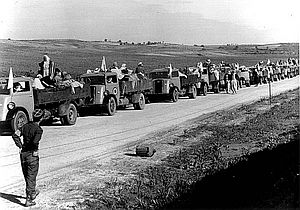 al-Nakba which is best translated as "the Humiliation" is how Palestinians describe the exodus of Muslims* in 1948 from the soon to be created nation of Israel. This was a "humiliation" created by Muslim intransigence, hatred, disunity, cowardice and a 20 year series of violent and disastrous judgements. For 70 years Palestinians and their supporters have claimed they were sent packing at the point of a gun and so, morally, they should be allowed to return to their homes of their ancestors despite the fact that those 700,000 have now become 5 million most of whom still seek the utter destruction of Israel and the death of it's non-Arab citizens.
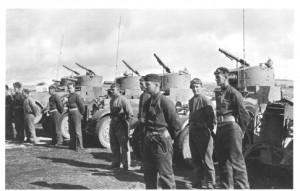 By February 1947 British government was sick of the cost of maintaining "peace" in Palestine and offloaded the problem onto the U.N. On November 30, partition of the area into 2 countries was decided upon despite unanimous rejection by all Muslim countries. A general strike was declared by the Arab High Committee on December 2nd and fighting broke out. Before the British Army evacuated, Palestinian Arabs supported by the "Arab Liberation Army" began attacks on the Jewish population.
The major difference between the Jewish and Arab forces was that nearly every able-bodied Israeli male became part of the army while very few Palestinian men fought in the conflict. In 1947/8 it was generally considered that the Jews would be defeated, if not by the Palestinians, then by the armies of the Arab League which had publicly announced their determination that the Arab army invasions would be "a war of extermination and a momentous massacre which will be spoken of like the Mongolian massacres and the Crusades."
On 4th May 1948 the Brisbane Courier-Mail reported:
"that Arab invasion plans are complete, the Daily Telegraph's special correspondent at Amman writes: 'Arab ministers and other leaders have now attained unity,' and the ascendancy of King Abdullah of Transjordan seems assured. 'An offer to the Jews of citizenship in a unified Palestine with local autonomy in Jewish majority areas is the Arabs' final word. 'If it is rejected full-scale war involving the regular forces of all the Arab States is inevitable. But there will be no penetration until the British mandate expires on May 15."
Palestine became an enormous black market in British arms and equipment which helped when Israel was invaded by armies commanded (the Arab Legion) or equipped by Britain. With the benefit of hindsight, experts now agree that the victory for the Jews was assured even if 1% of the Jewish population had to die in the process.
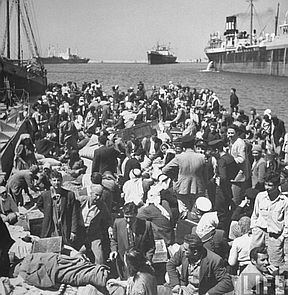
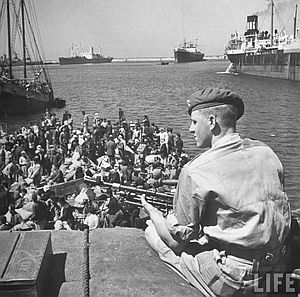
By May 3, 1948 with British troops still in control of the country the Arab High Committee had fled. Virtually all wealthy Arabs had gone as well and they were followed by entire Arab populations of major cities who fled suffering no casualties beforehand. Most of the population of Jaffa, Tiberias, Haifa and Acre fled even though British and Jewish authorities advised them to stay. Jerusalem was the only city in which the Arab population did not flee.
 The Adelaide Advertiser, 14th May:
"There are plenty of indications that it will not be a walk-over for the Jews, says the "Daily Mail" correspondent. The Arabs in a slashing counter-attack yesterday regained the western end of the historic mountain pass leading to Jerusalem. The successful attack is reported to have been led by the Arab commander Fawzi el Kawakji"
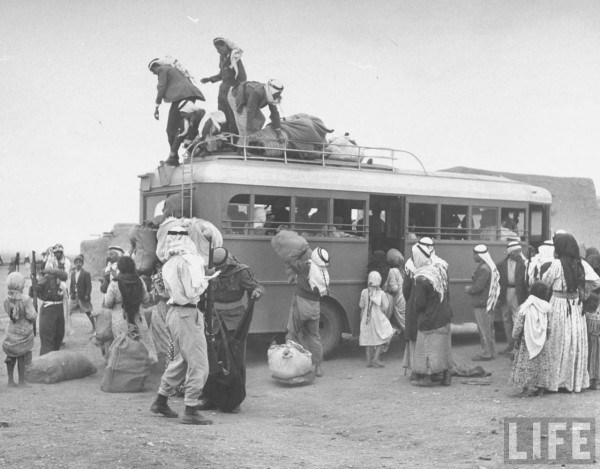
On the right a Life magazine photo of evacuation at Jenin. Note the unhurried atmosphere, the bus and the number of men standing around.
Personally, I find only 2 plausible explanations for the Palestinian behaviour. They believed the Israelis would do unto them what the Mufti and the Arab League boasted they would do - commit genocide - or they fled to avoid trouble until those Arab threats had been carried out.
Palestinians and their supporters are exponents of the "big lie" philosophy. There is a belief that if they continue to claim they were driven to leave their homes or suffer genocide - or have enough of their children killed in front of TV cameras - then the Israeli government will somehow be forced to resettle them in Israel. However, their places were taken in the years after when hundreds of thousands of Middle Eastern and North African Jews were forced from their homes, leaving their goods behind and emigrated to Israel.
Benny Morris, the "revisionist enfant terrible" historian who made his name attacking earlier Israeli historians explains the events succinctly:
In fact, what actually happened was this: The Arab states and the Palestinian national leadership, headed by Haj Amin al-Husseini, opposed the partition of Palestine, claiming all of Palestine for the Arabs. When the General Assembly voted in favor of partition, on 29 November 1947, the Palestinian leadership rejected the resolution and the Palestinian militias launched hostilities to abort the emergence of a Jewish state. They were aided by money, arms and volunteers from the Arab states. In the course of this first, civil-war half of the 1948 War (roughly from 30 November 1947 until 14 May 1948) the Palestinian militias attacked Jewish traffic and settlements for four months. But eventually the Jewish militias, chiefly the Haganah, went over to the offensive (in early April) and routed the Palestinians, and some 300,000 were displaced from their homes and lands. On 15 May 1948, the day after the Zionist leaders declared the establishment of the State of Israel, the armies of Egypt, Syria, and Iraq invaded Palestine, in defiance of the will of the international community, as embodied in the partition resolution, and attacked the Jewish state. The army of Jordan, the fourth invading army, occupied the West Bank and East Jerusalem, the core of the territory earmarked in the partition resolution for Palestinian Arab statehood. (The Palestinians failed to declare statehood, and Jordan did not allow the Palestinians to establish a state and subsequently formally annexed the West Bank and East Jerusalem. Egypt emerged from the war in control of the Gaza Strip.) During the weeks and months after 15 May, the Israeli army contained the invading armies and eventually drove them out of most of Palestine. Another 400,000 Palestinians were displaced from their homes in the course of the fighting: Some were expelled by Jewish troops (for example, from Lydda and Ramle in July 1948), some were advised to leave or ordered out by Arab leaders and officers (for example, from Haifa in April 1948 and Majdal in October). But most of the 700,000 simply fled out of fear of being caught up and harmed in the fighting. In summer 1948 the Israeli government decided not to allow the displaced Arabs-most of whom ended up in refugee camps in other parts of Palestine, i.e., the West Bank and Gaza-to return to the area of the State of Israel, deeming them inimical (they had just assailed the Jewish community and tried to destroy the Jewish state) and a potential Fifth Column.
- It will also be said that the Arabs of Palestine have proved themselves weak and impotent; that no sooner had
the first bombs fallen than they fled in utter rout, evacuated their cities and their strongholds, and surrendered
them to the enemy on a silver platter, that a large number of them had fled even before the battle and had
taken refuge in the other Arab countries and in remote regions of Palestine
The explanation of the victory which the Zionist have achieved-and only a person who deceives and blinds himself can deny the victory-lies not in the superiority of one people over another, but rather in the superiority of one system over another. The reason for this victory is that the roots of Zionism are grounded in modern Western life while we for the most part are still distant from this life and hostile to it. They live in the present and for the future while we continue to dream the dreams of the past and to stupefy ourselves with its fading glory. - Mena al-Nakbah The Meaning of the Disaster by Constantine K. Zurayk, August 1948 - If ultimately the Palestinians evacuated their country, it was not out of cowardice, but because they had lost all confidence in the existing system of defense. They had perceived its weakness, and realized the disequilibrium between their resources and organization, and those of the Jews. They were told that the Arab armies were coming, that the matter would be settled and everything return to normal, and they placed their confidence and hopes in that. Moreover, they had before them the specter of Deir Yassin - The Message of Palestine, Musa Alami, The Middle East Journal, Volume 3, No. 4, October 1949, pp. 373-405
Revisiting the Palestinian exodus of 1948 - Benny Morris
These main conclusions were that the refugeedom of the 700,000 Palestinians was essentially a product of the war, of the shelling, shooting, and bombing, and of the fears that these generated. But the flight of the Palestinians was also due to their incompetent, self-serving, and venal leadership, a leadership that failed to prepare properly for war, then plunged headlong into it, and, finally fled at the first whiff of grapeshot, leaving behind leaderless, bewildered, and defeated communities, which then also took flight. Concomitantly, the months of fighting caused the collapse of Palestinian urban society, creating joblessness, increased food prices, and poverty. The gradual exodus, which began with the upper and middle classes, was pushed along by the Haganah, the Irgun Zvai Leumi (IZL or simply "Irgun," lit. National Military Organization), the Lohamei Herut Yisrael (LHI or simply "Stern Gang," lit. Freedom Fighters of Israel), and IDF expulsions at specific sites; by orders in certain areas and towns by local Arab officials and Arab troops to groups of Palestinians - such as women and children - or to specific communities to leave their homes and clear the battlefield; and to Israeli atrocities which unnerved and panicked neighboring communities. The Arab states also contributed to the Palestinians' refugeedom by failing at certain crucial junctures to give the Palestinians clear signals about whether or not to leave and, subsequently, by invading Palestine and then rejecting a succession of proposed compromises and by failing to absorb the refugees in their own countries. Above all, let me reiterate, the refugee problem was caused by attacks by Jewish forces on Arab villages and towns and by the inhabitants' fear of such attacks, compounded by expulsions, atrocities, and rumors of atrocities - and by the crucial Israeli Cabinet decision in June 1948 to bar a refugee return.
- An enlightening and extensive 60 year series of sourced quotes by Arab leaders referrring to Israel is available here.
* How many Muslims left Israeli controlled territory in 1948? Arab sources claim up to 750,000. In August of 1948 Count Folke Bernadotte, the U.N. Mediator in Palestine, reported 330,000 refugees numbered. By October, 1948 the number reported was 500,000. In October, 1950 the U.N. settled on 711,000.
There is a startling number of books written about these events, which without their geo-political ramifications, would be a rather minor conflict by historical standards. The two "sides" might as well come from different planets - I'm obviously from the planet Bella Judaica. I find the works of the "New Historians" from the more nuanced books to the Manicheism of Illan Pappé unconvincing except as a necessary corrective to the Leon Uris vision of Israel's founding. Unfortunately Israel has now become the defining ethical and moral question of our time according to the political Left and any realistic account will not come from that direction - but some books I've found helpful include:
Extra Information:
- The Nakba: Catalyst for pan-Arabism Al Jazeera
- Nakba Skepticism
- The Beginnings of the Palestinians' Mass-Flight Yoav Gelber
- The Other Exodus: exposing the Israeli lie that Palestinian leaders ordered the flight of 1948 - Erskine B Childers
Books and Articles:
- The Meaning of the Disaster - Constantine Zurayk
- The Lesson of Palestine - Musa Alami
- Promise and Fulfilment: Palestine 1917-1949 - Arthur Koestler
- This is Israel - I.F. Stone
- The Mufti's Islamic Jew-Hatred - Andrew G. Bostom
- One Palestine, Complete: Jews and Arabs under the British Mandate - Tom Segev
- Nazi Palestine: The Plans for the Extermination of the Jews in Palestine - Mallmann et al
- The Arab-Israeli Conflict: The 1948 War - Efraim Karsh
- Fabricating Israeli History - Efraim Karsh
- 1948: A History of the First Arab-Israeli War - Benny Morris
- The Birth of the Palestinian Refugee Problem, 1947—1949 - Benny Morris