The Grand Mufti
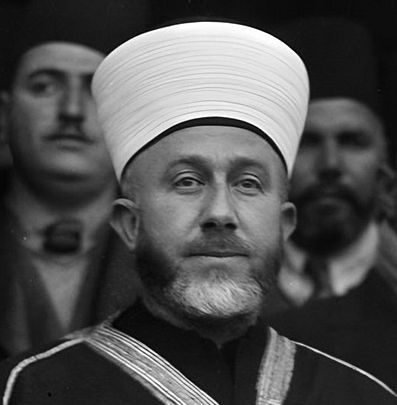 From the mid-19th century the al-Husaynis became the dominant power in Jerusalem as religious leaders (Muftis) and officials in the Ottoman administration. They were large landowners, mayors and delegates to the Ottoman parliament. Hajj Amin al-Husayni was able to concentrate that power even more as Grand Mufti and president of the Supreme Muslim Council, giving the family control over religious courts, schools, and lucrative religious funds (awqaf). In 1936 the Arab Higher Committee was created, unifying, as much as possible, the Palestinian notable clans and their political parties under his control.
al-Husayni had only one Zionist policy throughout his career. It was maximal rejectionism. The could be no Jewish home(land) in Palestine. He would not compromise with the Zionists or the British Mandate authority policy on a Jewish home. It was unacceptable. However, he did not seem to have an possible way of defeating both the British and the Zionists. He was able to maintain near dictatorial power over his fellow notables and the fellaheen but was unable, or didn't care, to alleviate the poverty of the fellaheen. The British administration worked to improve Palestinian health and education but were hampered by the British government insistence on the administration relying on finance from local taxation.
The Arabs petitioned the British government to grant Palestine democratic self government but this was a farce. They not only never made any real steps towards creating a governmental structure but al-Husayni was already a dictator of the Arabs in everything but name. Any self governing entity wouuld have gone the way of all Arab democracies:- under a vicious dictatorship, after all the Arabs already were.
From the early 1930s al-Husayni tried to secure an alliance with Nazi Germany and Fascist Italy. He thought that an Axis victory would expel the British from the Middle East and lead to a German-backed ban on Jewish immigration and the eradication of the existing Jewish population. This was not an unrealistic hope and in 1941 he worked for Germany in Iraq and in Germany for the rest of the war. After WW2 he tried to defeat the Zionists by leveraging a pan-Arab coalition (with himself at its leader), forming irregular local militias and by using the anxieties of Arab leaders about their fate if the "street" should believe they were not serious about fighting the Jews.
Alignment and Early Contacts (1933-1940)
- al-Husayni initiated contacts with German officials as early as 1933, shortly after the Nazis took power, viewing them as natural allies against Zionist expansion in Palestine.
- By the mid 1930s, he sought financial and military assistance for the Arab Revolt against British rule, receiving support from Fascist Italy using Musa Alami as ago-between
- In October 1937 al-Husayni hid in the Temple Mount when a warrant for his arrest was issued. He went to Iraq and escaped to Berlin in 1941 after after British forces defeated the uprising. He fled to Iran and then to Italy.
- al-Husayni arrived in Berlin in November 1941, where he was treated as a high-ranking guest and propagandist for the Reich
- On November 28, 1941, al-Husayni met with Adolf Hitler. He expressed admiration for Germany and stated that the Arabs were Germany's "natural friends" because they shared the same enemies.
- The Mufti asked Germany to pledge support for Arab independence and unification. Hitler happily supported the "removal" of the proposed Jewish national home in Palestine.
- Hitler declined to make a public declaration at the time, stating that Germany's goal was the annihilation of Jewish power in the Middle East, which would be pursued once German forces reached the area.
- al-Husayni headed the Arab Bureau of Joseph Goebbels's Propaganda Ministry, making regular radio broadcasts to the Arab world that mixed Nazi ideology with antisemitic interpretations of Islamic history which is the straightforward interpretation
- The Nazi regime provided him with a luxurious villa in Berlin-Zehlendorf and a generous monthly stipend (reported around 62,500 Reichsmarks).
- He played a key role in recruiting Bosnian Muslims into the Waffen-SS "Handzar" division, aiming to form a Muslim SS legion.
- In 1943, al-Husayni intervened with authorities in Germany, Bulgaria and Hungary to stop plans that would have transported thousands of Jewish children to safety in Palestine, suggesting instead they be sent to Poland (where they were subjected to "stricter control," meaning extermination).
- In May 1945, as the Nazi regime collapsed, al-Husayni was captured by French forces in Germany.
- He was put under "house detention" in France but was allowed to "escape" in 1946, eventually settling in Egypt, where he continued to play a role in Arab nationalist politics.
- As a leader of a group of Untermenschen, al-Husayni had little influence on the overall Nazi Final Solution but historical documentation shows that he was a willing collaborator who "willingly aided" the Holocaust as best he could while he lived in expectation and hope.
General Evelyn Barker, pro-Arab and anti-semite, wrote a letter to his lost love, Katy Antonius, from New York at the vote for partition:
General Evelyn Barker felt obliged to apologize. His government had not been fair. It should not have returned the mandate to the U.N. in New York, since the atmosphere there was so pro-Jewish. On the other hand, he wrote to Katy Antonius, he could not blame the British - even Haj Amin al-Husseini, the former mufti, thought only of his own interests and not of his people, and had done the Palestinian Arabs a great disservice. The mufti sought only to augment his political power. The Arabs had only dissension and petty jealousies. Their tragedy was that they had no real leadership. - One Palestine, Complete: Jews and Arabs Under the British Mandate - Tom Segev
Imperial Perceptions of Palestine-British Influence and Power in Late Ottoman Times - Lorenzo Kemal
Hajj Amin al-Husayni. He imposed himself as a champion of the Palestinian cause
until the 1940s, although his efforts were 'soiled' by his collaborating and sympathizing with Adolf Hitler and Nazism:2
Arab nationalists express their utmost gratitude to Your Excellency [Adolf Hitler] for having brought up the issue of
Palestine on many occasions. […] I take this opportunity to delegate my Private Secretary to the German Government in order
that, in the name of the largest and strongest Arab organization and in my name, he can begin the negotiations required for sincere, loyal cooperation in all fields.3
2 The connivance of Hajj Amin with Nazism should be read in an anti-Zionist
perspective, infused with anti-Semitic prejudices (he did not hesitate to cite on several occasions The Protocols of the Elders of Zion) and anti-British stands. His
intransigence towards Jews had deep roots. According to various sources, Hajj Amin did not recognize to Jews the right to pray at the 'Wailing Wall', but
only to visit it. See 'A. Kayyali, Watha'iq al-Muqawama al-Filast? iniya al-Arabiya [Documents on the Arab-Palestinian Resistance] (Beirut: Mu'assassat al-Dirasat al-Filastiniya, 1968), pp. 119-26. Haim Gerber pointed out that in
numerous documents written by Zionist leaders it was expressed the will to demolish the buildings on the 'Temple Mount' to make space for a new Jewish
Temple: 'It is in this light', Gerber clarified, 'that we may understand Amin Husayni''s objection to any compromise with the Zionists over the Buraq/
Wall'. Gerber, Remembering, p. 178. On this aspect see TNA CO 733/175/2. Dispatch from Isaiah Braude and Solomon Horowitz, representatives of the
Zionist Executive, to the British authorities in Palestine, 19 Aug. 1929.
3. Al-Husayni to Hitler, 20 Jan. 1941. The following year the Mufti congratulated the 'Führer' for his victories in North Africa, speaking on behalf
of the entire Arab world: 'Das arabische Volk wird daher an Ihrer Seite gegen den gemeinsamen Feind bis [zum] endgültigen Sieg weiterkämpfen [The Arab
people will continue to fight by his side against the common enemy until the final victory].' CZA L35/59-4. Berlin, 4 July 1942. The position of Amin
al-Husayni is particularly problematic considering that he wrote in his private diary the intentions outlined by Hitler during a meeting that they held on 21
November 1941: 'The objectives of my fight', Hitler explained, 'are clear. Primarily, I am fighting the Jews without respite […] I am resolved to find a
solution for the Jewish problem, progressing step by step without cessation.' JMA - Box 7005 - Mishpacha Husayni ('Husayni Family').
4. A. 'Abd al-Ghani, Almaniya al-Naziya wa Filastin, 1933-1945 [Nazi Germany and Palestine, 1933-1945] (Beirut: Inst. for Palestine Studies, 1995),
pp. 326-34. Some isolated cases that go in the opposite direction to what was just claimed can be found in A. Jaddu 'Ubaydi, Safah at min hayat al-Hajj Amin al-Husayni
[Pages from the life of Hajj Amin al-Husayni] (al-Zarqa': Maktabat al-Manar, 1985), pp. 134-5, and H. A. Jarrar, Hajj Amin al-Husayni ('Amman: Dar al-Diya', 1987), pp. 218-36.
5. D. G. Dalin and J. F. Rothman, Icon of Evil: Hitler's Mufti and the Rise of Radical Islam (New York: Random House, 2008).
6. D. Patterson, A Genealogy of Evil (New York: Cambridge University Press, 2011), p. 108. According to Patterson, 'the Palestinians were pleased to be
deeemed honorary Nazis after their leader, Haj Amin al-Husseini, paid homage to Hitler.' D. Patterson, 'Toward a post-Holocaust Jewish
understanding of the Jewish State', in L. Grob and J. K. Roth (eds), Anguished Hope (Grand Rapids: Eerdmans Pub., 2008), p. 123
Palestine 1936: The Great Revolt and the Roots of the Middle East Conflict - Oren Kessler
On January 30, 1933 Hitler became Chancellor of Germany. On March 31 the Mufti arranged a meeting in the German Consulate:
"Today the mufti told me that Muslims inside and outside of Palestine greet the new regime in Germany, and hope for the spread of Fascist and
anti-democratic state authority to other lands," the consul cabled Berlin, and Amin was ready to promote any anti-Jewish boycotts the Nazis may lead.
Several weeks later the consul again met the mufti and other Palestinian
notables, this time at the desert shrine at Nebi Musa. They proclaimed their admiration for the new Germany and sympathy for Hitler's anti-Jewish
measures. They asked one thing: that the government do all it could to keep Jews from Palestine.
Collusion Across the Jordan - Avi Shlaim
Page 68: The possibility of incorporating any part of Palestine in Abdullah's kingdom thus fell by the wayside and there was a clear strengthening of the
position of the mufti; the Arabs of Palestine acclaimed him as their sole representative and demanded that he be accepted as such by the other
Arab statesmen. The British, in need of stability in the Middle East in order to concentrate on the challenge posed by Nazi Germany in
Europe, hurriedly retreated from the three main prescriptions of the Peel Commission: partition, an independent Jewish state, and a direct
role for Transjordan. Instead, they now offered to grant independence to a federal state after a transition period of five years, with restriction
on Jewish immigration and on the sale of land to the Jews. The Jewish representatives were desperately opposed to the British plan and even
considered walking out of the conference. The Arab statesmen and some of the mufti's own supporters urged him to accept it, underlining
the magnitude of the British concessions, the value of having Britain on the side of the Palestinians in this struggle against the Jews, and the
bright prospects it held out for further gains. But at this critical moment, when Arab leverage was at its peak, the leader of the
Palestinian Arabs in effect rejected the British plan by insisting on a shorter transition period. A golden opportunity for creating an
independent, unified Palestine was allowed to slip away. It was not the first blow inflicted by the mufti on the cause he was supposed to be
serving nor was it to be the last, but it was probably the most devastating. Through the stubborn maximalism which had by now
come to dominate his political outlook, he squandered the chance to have his own state, a chance that had emerged out of a unique set of
historical circumstances. The London conference dispersed amid confusion and with an inaudible sigh of relief on the part of Abdullah and the Jewish representatives.
16 Sharett, Political Diary, iii. 219 f.
Zionism and the Palestinians - Flapan Simha
In May 1939 the Arabs were near total victory in their struggle against Zionism. Had they accepted the White Paper of 1939, and co-operated with Britain on its implementation, it would have been most difficult for the Zionist movement to put together again the shambles of its broken strategy. What saved Zionist chances was the fatal decision of the Mufti to stake the future of the Palestinian people on the collapse of Britain's rule in the Middle East and on Nazi military victory in the approaching World War II. The moderates of the National Defence Party were in favour of co-operation with Britain and its White Paper policy. The Mufti, however, was already engaged in preparing for an Arab revolt against Britain in the forthcoming war. A civil war ensued between the two factions, causing thousands of casualties, destruction, chaos and flight from the country, the Palestinian people were left without a leadership or an authoritative and realistic policy and in that state drifted, disorganised and confused, down the road to national calamity.
The switch from strategy based on a treaty with Great Britain to a gamble on Hitler's victory in the approaching war had its origin in 1937 when the Mufti escaped to Lebanon to avoid detention by the British. Even before, in September 1937, he urged the all-Arab Conference of Committees for the Defence of Palestine, which issued a warning to Great Britain that the continuation of its pro-Zionist policy would compel the Arabs to ally themselves with the powers opposed to Great Britain. Immediately afterwards he engaged in all-Arab campaigns to form an alliance between the Arab world and the Axis powers. To understand his predilection for the anti-British powers in Europe one has to bear in mind that unlike Raguib Nashashibi, the leader of the Defence Party, the Mufti was concerned not only with the future of Palestine Arabs but with Arab politics in general. He was a mediator in the war between Saudi Arabia and Yemen in 1934, he was President of the World Islamic Conferences in Jerusalem in 1931 and of subsequent conferences in Karachi and Bagdad and played an important role in Iraq, where, after his exile from Palestine, he wielded a considerable influence.1 His position in Palestine and in Arab politics brought him to rally with Arab leaders dominated by the feelings of frustration and resentment against Britain and France which prevented Arab unity in 1918 and divided among themselves the Arab countries in the Middle East and later impeded and obstructed their independence. Hitler's spectacular rise to power and his prestige in the wake of his conquests in Europe, and Mussolini's penetration into Africa and occupation of Libya and Ethiopia, had generated hopes for a collapse of British rule in the Middle East and intensified anti-British feelings. The social background of the Mufti and his followers facilitated the transformation of these feelings into sympathy for the authoritarian and military dictatorships in Germany and Italy and their policies. The speculation on a new Arab revolt in the approaching war, this time against Great Britain, began to occupy the minds of many Arab politicians in Syria, Iraq and Egypt and the Mufti was one of the first to embrace this idea. Already in January 1938, he was reported as having said (raising his finger) to the intermediaries in the negotiations with Dr Magnes: 'I see the independence of Palestine as I see my finger.'
He was not swayed from his pro-Nazi orientation even by the White Paper of 1939, which gave to the Arab Higher Committee in Palestine most of its demands. The Mufti forced through a decision to reject the White Paper and its recommendations. A desperate attempt was made by the Defence Party to have them accepted. In July 1939, a number of commanders of Arab rebel groups issued in Damascus a manifesto calling for the acceptance of the White Paper which 'forms [a] good basis for the realization of natural aspirations in the cause for which we have fought'. The manifesto accused the Mufti and his adherents of having rejected the White Paper because 'they aim at serving some foreign interests in consideration of fixed remuneration'.3
The manifesto was widely circulated in Palestine and given large publicity but amounted to no more than a feeble and abortive attempt to undermine the Mufti's authority. In the civil war that raged in Palestine between the two factions in 1937-9 the 'Peace Bands' organised by the Nashashibis, with British (and some Jewish) aid, managed effectively to assert themselves and repel the attacks of the Husseini gangs, though a number of prominent leaders of the Defence Party were assassinated in the process.3 Among the exiled politicians and members of the Arab Higher Committee the Mufti wielded the power and remained the undisputed leader of the Palestine Arabs. His policy appealed to many Arab leaders abroad and brought him increased prestige and popularity.
On 9 May 1941, the Mufti declared a 'Jihad' against Great Britain and after the failure of the Iraqi revolt in 1941, he proceeded to Berlin, where until the end of the war he offered his services in mobilising Moslem populations in Europe for Hitler's armies, in fostering pro-Nazi elements in the Arab countries, and even in collaborating with Himmler and Eichmann, the planners of the 'final solution' of the Jewish problem.4 This policy resulted in disaster for the Palestinian Arabs. Though a fatal adventure, at the time it could hardly be classified as such. The prospects of an Allied victory in 1941 and 1942 seemed so gloomy and those of the Axis so promising that orientation towards the latter appeared a reasonable risk, carrying the promise of success.
Britain and the Arabs - Sir John Bagot Glubb
In the previous pages, I have ventured to record many criticisms of the American and British governments and of the Zionists. To obtain a balanced picture, it is essential to discuss also the conduct of the Arab case. For the first twenty years or thereabouts, the defence of the Pales- tine Arab cause was conducted by themselves, under the leadership of the mufti, Haj Ameen al Husaini, His policy was characterized by an intense narrowness and by an utter refusal to compromise. He took the view that the mass immigration of Jews to Palestine, contrary to the wishes of the majority of its inhabitants, was unjust. The claim that, nearly two thousand years ago, the country had belonged to the Jews had, for its Arab inhabitants, no more validity than if the Americans were today to attempt to seize England, on the grounds that their ancestors had once migrated from there.
Even, however, if we admit that there was justice in his claim, we are obliged to recognize that his methods were lamentable. He was un- aware that politics is the scicnce of what is possible. Purely abstract justice is rarely obtainable in this imperfect world, and we must needs make do with what justice we can obtain. Several opportunities for com- promise presented themselves during the first twenly years, but all were utterly rejected, on the grounds that no Jewish immigrants at all should have been allowed to enter Palestine without the consent of its people. Had the Mufti been a more practical politician, there is at least a possi- bility that catastrophe might have been avoided.
In the 1930s, Arab terrorists operated in Palestine on a considerable scale, particularly against other Arabs, accused of lack of patriotism. This is a development to which modern race fanaticisms seem pecu- liarly liable. Terrorists often kill more of their own compatriots, who are allegedly lukewarm in the cause, than they do of the "foreign enemy". The activities of the terrorists tended to discredit the Mufti's leader- ship in Palestine. Had he been a patriot with high moral standards, it would have been difficult to resist a demand for his return to Palestine after the Second World War. The majority of the Palestinians were sick of terrorism and insecurity and longed for law and order, stable adminis- tration and settled government. After the fighting with Israel, the Pales- tinians themselves opted for unification with Jordan.
During the Palestine rebellion, which lasted from 1936 to 1939, the Arab states began to play an increasing role in the Palestine situation. At first the influence of Iraq, Saudi Arabia and Jordan was exercised in favour of moderation. After the Second World War, however, and with the formation of the Arab League, Egypt assumed the leadership. She, supported by Syria newly freed from French control, adopted the un- compromising extremism of the mufti, and thereby plunged the country into the fighting of 1948. After the resulting catastrophe, the Arab League accepted the 1947 partition plan, which it could originally have obtained without fighting.
The Struggle For Palestine 1936-48 J. C. Hurewitz
"Italy, which knows Husseini's feeling of friendship for the Duce and the Fascisti," read the official Italian announcement of al-Hajj Amin's arrival in Rome at the end of October 1941, "is glad to learn that he is safe and sound on her territory." 12 Radio Rome characterized the Mufti's first meeting with Mussolini and Ciano as "an important event in the future of the Arab countries." Early in November the Mufti paid his initial visit to Berlin, where a Foreign Office spokesman greeted him "as a great champion of Arab liberation and the most distinguished antagonist of England and Jewry," going on to assert that the Germans would accord "him the full honours due to his 'exalted' rank." The Axis publicity campaign, dwelling at length on the Mufti's personal history and his struggle against Britain, was most intensive in the first three months of his European so journ. The Italian press played up the manner in which he had eluded the British and Russians in Iran, describing the event "as a British defeat." Radio Berlin referred to him as "one of the great leaders of the Arab and Moslem world who have received at the hands of Britain enough to make her the greatest enemy and hangman of Islam." 18
The Mufti seemed determined to secure from the dictators an unequivocal statement on the position of the countries in the Arab East after the expected Axis victory. He apparently wished to establish, before the war's end, his own future status as a leader in an independent Arab world. Other wise there was little incentive for his collaboration. But at last al-Hajj Amin had met his superiors in intrigue. Despite numerous drafts of such declarations, he was unable to obtain the signatures of either Hitler or Mussolini. Nevertheless, on November 21, 1941 the Mufti was granted a ninety minute audience with Hitler. The Fuehrer emphasized that a public statement would have to wait until his Panzer divisions and Luftwaffe had reached the Southern Caucasus. But he gave al-Hajj Amin oral assurances, cautioning that they be kept secret for the time being, that,14
Germany has no ambitions in this area [the Arab countries of the Near East] but cares only to annihilate the power which produces the Jews. … The hour will strike when you will be the lord of the supreme word and not only the conveyor of our declarations. You will be the man to direct the Arab force. …
Accompanied by Rashid 'Ali, who had fled in December 1941 from his Turkish asylum to Europe, al-Hajj Amin also managed to secure a secret, written confirmation of Italian pledges to the Arabs from Foreign Minister Count Ciano, reading in part: 15
The Italian Government fully appreciates the confidence placed by the Arab people in the Axis powers and in their objectives, as well as their in tention of participating in the fight against the common enemy until final victory is achieved. This is in accord with the national aspirations, as conveyed by you, of the Arab countries of the Near East at present oppressed by the British. I have the honor to assure you, in full agreement with the German government, that the independence and freedom of the Arab countries, now suffering under British oppression, are also the objective of the Italian Government.
Italy is therefore ready to grant to the Arab countries in the Near East … every possible aid in their fight for liberation; to recognize their sovereignty and independence; to agree to their federation if this is desired by the interested parties; as well as to the abolition of the National Jewish Homeland in Palestine.
Meanwhile, the Mufti was given a roving, elastic mission, amply financed and well staffed. He and his Arab colleagues were placed at the disposalof the Axis propaganda and foreign ministries and armed forces. The Mufti worked closely with the Nazi specialists on the Near East, including Palestine-born Templars who had left for Germany a few days before the outbreak of war in 1939. A special Arab Office, known in Germany as "Das Arabische Büro" (al-Maktab al-Arabi), was created, and al-Hajj Amin installed as one of the directors. He styled himself "Der Grossmufti" or Grand Mufti (al-Mufti al-Akbar)y dropping altogether the territorial qualification, "of Jerusalem," which he had used since the 1920's-further proof that al-Hajj Amin's ambitions extended beyond Palestine's borders. The headquarters of the Arab Office in this period were in Berlin, with subsidiary bureaus in various cities of Germany, Italy, and the occupied countries.16